 PaperPicks.
Yes, Kalshi simulators exist, in three lanes: Kalshi's official demo (real interface, simulated prices), browser paper trading sites (uneven), and PaperPicks, a free iPhone app mirroring live Kalshi-sourced odds with a $100 paper bankroll, real settlement, and no signup. None of them charges Kalshi's real trading fees, ours included, so read any paper P&L as slightly flattering.
What counts as a Kalshi simulator#
A Kalshi simulator is anything that lets you trade Kalshi's event contracts, the YES or NO questions priced between 1¢ and 99¢, without putting real money on the exchange. There are exactly three credible ways to simulate Kalshi trading in 2026: the official demo environment Kalshi runs, a handful of browser paper trading sites, and PaperPicks, our free iPhone app that mirrors live Kalshi-sourced odds.
The word simulator carries different weight in each case. The demo reproduces Kalshi's interface around fake prices. The browser sites reproduce Kalshi's markets in a desktop tab, with fidelity that varies site to site. PaperPicks reproduces the prices themselves and settles positions when the real markets resolve. A Kalshi trading simulator earns the name by keeping the parts that matter real: live prices, real settlement rules, sizing pressure from a bankroll that can bust, and some honesty about the fees the exchange would be charging you. Fake money is the one thing all three get right, and it is the least interesting item on that list.
Three ways to trade Kalshi with fake money#
Kalshi's official demo. A separate account at demo.kalshi.co with mock funds and a faithful copy of the real interface. It was built for developers testing bots against the API, and it still behaves like it: the order books are simulated, and Kalshi's own docs warn that demo prices "may not be reflective" of real markets. If you were searching for Kalshi free play, this is what officially exists. It is genuinely useful for learning the interface before wiring in money, and setup takes a few minutes; the walkthrough is in our Kalshi demo account guide. Just do not grade your trading on it. Prices with no crowd behind them cannot tell you whether your reads are good.
Browser paper trading sites. Third-party web sims that track Kalshi markets with a mock balance, usually behind an email signup, often with a leaderboard. The category is uneven in predictable ways: odds that lag the exchange, settlement that varies by site, and balances you can often reset, which quietly deletes the consequences that make practice mean anything. Fine if you trade from a desk. Ask two questions before trusting one: where the odds come from, and what survives a bad week.
PaperPicks. A free iPhone app with live odds sourced from public prediction markets, the same event contracts trading on Kalshi, and positions that settle when the real markets do. No signup, permanent record, $100 paper bankroll. Details two sections down.
| Kalshi demo | Browser sims | PaperPicks | |
|---|---|---|---|
| Odds source | Simulated order books | Exchange odds, often delayed | Live, mirroring public markets |
| Settlement | Mock, inside the demo | Varies by site | When the real market resolves |
| Platform | Web only | Web only | iPhone app |
| What persists | Separate demo account, no public record | Balances often resettable | Permanent server-scored record |
| Cost | Free | Free, email signup typical | Free, no signup |
The demo rehearses the interface and does that well. Browser sims are too uneven to generalize. If the point is finding out whether your reads are any good, practice where the prices are real.
What to actually simulate#
Seat time in a simulator is worth exactly what you drill during it, and most people drill nothing. They click, win or lose fake money, and none of it transfers. Four things do transfer, because they are the four things real Kalshi trading punishes.
Sizing against a bankroll that can bust. Mock funds are usually so plentiful that no position ever feels like a decision, and a sizing decision you cannot feel is not practice. A scarce roll fixes that. When one contract position is a fifth of everything you have, you meet the discomfort that real trading is mostly made of, and you meet it for free.
Reading the price, and knowing what you are not reading. A 34¢ contract is the crowd saying 34%, and drilling that translation until it is reflex is most of the job. Be clear about the part no simulator reproduces, though: book depth and slippage. The demo shows you an order book, but a fake one. PaperPicks shows you the real printed price, but you take it as printed rather than resting limit orders inside the spread. If your eventual plan is maker-heavy, a simulator teaches you the reads, not the fills.
Resolution rules, not headlines. Kalshi contracts settle on written criteria, and the criteria are routinely narrower than the headline. The game ends, everyone agrees who won, and the contract still resolves NO because the market asked a more precise question. The only way to drill this is holding positions through real resolution and eating the occasional surprise on paper. Mock settlement cannot ambush you, and the ambush is the lesson.
The fee you are not paying. Kalshi rewrote its fee schedule on July 7, 2026. The general taker formula is 0.07 × contracts × price × (1 - price): it peaks at 1.75¢ per contract on a 50¢ market, about 3.5% of the position, shrinks toward the extremes, and carries per-series multipliers on some products. Almost no simulator charges any version of this, and PaperPicks does not either. Paper fills are free, so a paper record runs slightly better than the identical trades would on the exchange, and the gap is widest at mid prices where the curve peaks. A 2¢ paper edge on a 50¢ contract is a 0.25¢ edge after the real taker fee. That flattering bias is baked into our own product, and we would rather name it than have you discover it with money on the line. Haircut thin edges, and remember that on the real exchange, resting limit orders fill without fees on most series.
Practice Kalshi trading on live odds#
PaperPicks is the lane we built, so here is precisely what it simulates and what it skips.
You start with a $100 paper bankroll. The odds are live, mirroring public prediction markets, the same event contracts trading on Kalshi right now: NFL, NBA, and MLB games, elections, Fed decisions, Bitcoin targets, award shows, 7,000+ markets in all. When news moves the real price, your screen moves with it, in play, point by point.
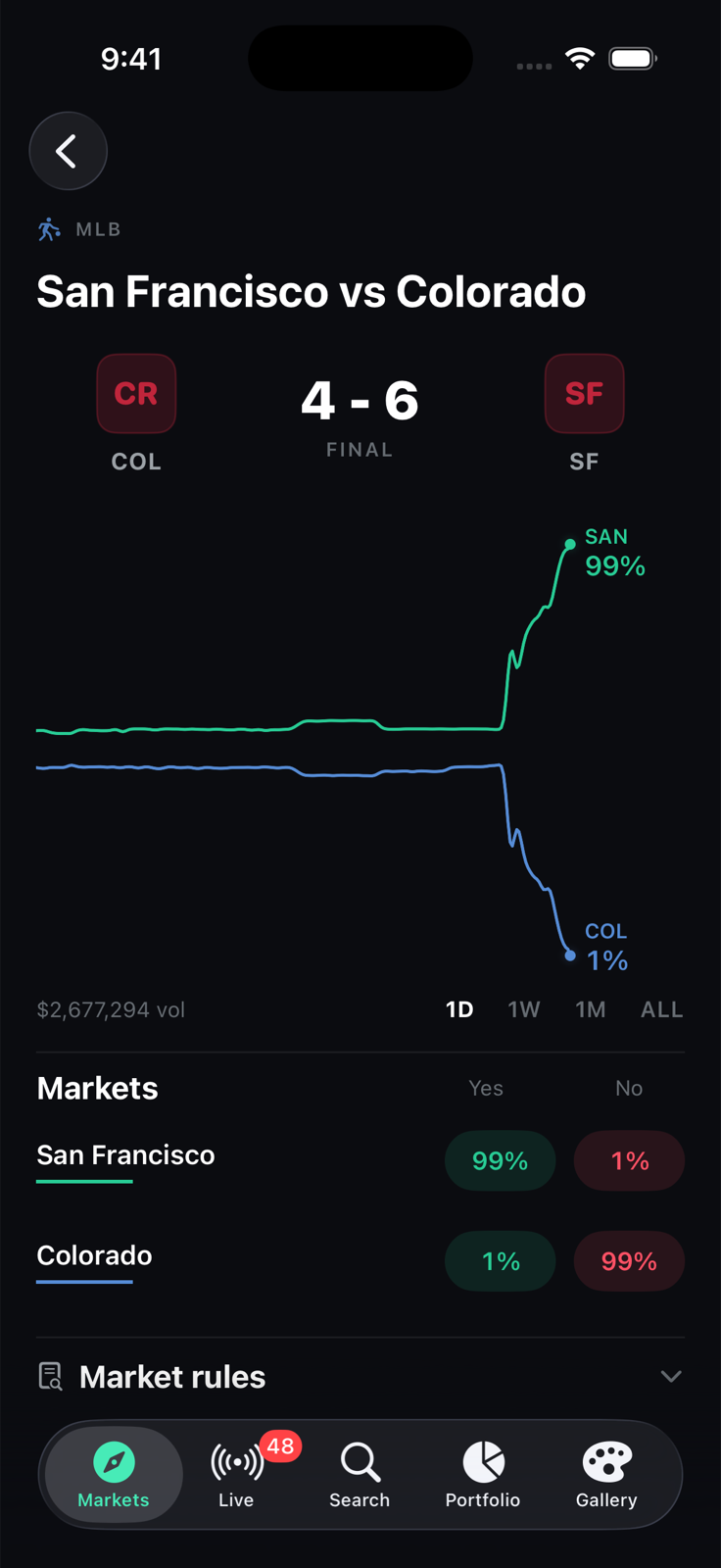
Settlement is real. Positions resolve when the underlying markets resolve, by the real ruling, and the receipt arrives as a push notification whether you want it or not. The record is permanent and scored server-side, no resets, and it feeds leaderboards and a social layer where you follow other traders and tail or fade their picks. There is no signup and no KYC; install to first trade is under a minute, and nothing you trade is ever real money. If you want Kalshi without real money anywhere near it, this is the closest thing that runs on a phone.
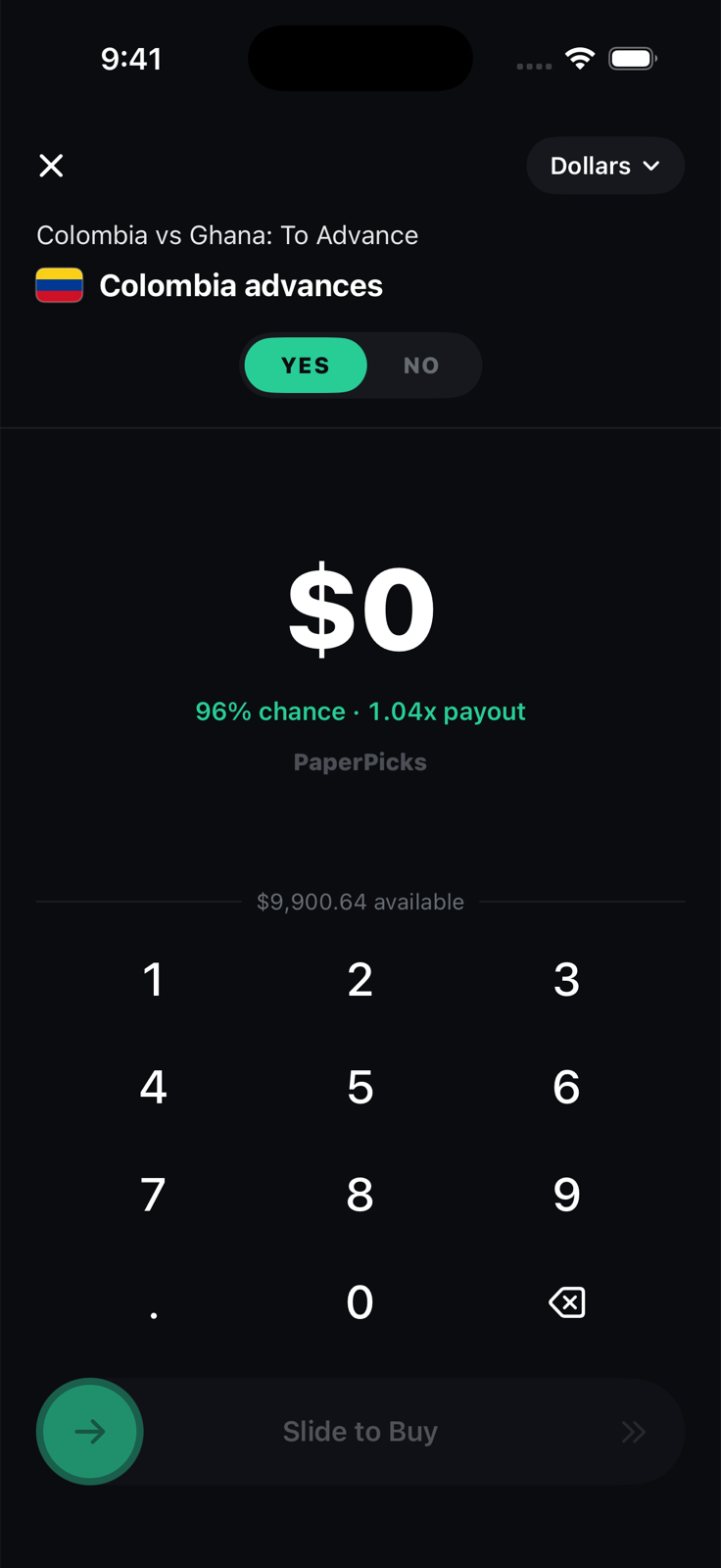
What it skips, said plainly: order book depth, partial fills, and the fee drag covered above. Every option on this page skips those too. We are just the one telling you.
The longer case for practicing on live odds, including a closer look at what the demo can and cannot teach, is in Kalshi paper trading. The short version fits in a sentence: fake money is the easy part, and everything that matters is what stays real around it. Download PaperPicks, pick tonight's game, and find out what your reads are worth with the hundred dollars that never costs anything.
- Kalshi fee schedule, July 7, 2026 update (PDF) — the taker fee formula and per-series multipliers
- Kalshi docs: Test in the demo environment — the demo environment description and the price-realism warning
Facts checked against primary sources on July 24, 2026.