 PaperPicks.
Kalshi is the pick for US sports and economics: deeper books there, dollar banking that pays interest on idle cash, and apps on iPhone, Android, and web. Polymarket is the pick for politics and world events, and since May 12, 2026 its CFTC-regulated US app is open to anyone 18 or over, with taker fees slightly below Kalshi's. Both now charge fees and both are regulated in the US, so choose by what you trade, and practice the identical mechanics with fake money before funding either.
The verdict#
Kalshi is the better exchange for US sports and economics. Polymarket is the better exchange for politics and world events, and since July 1, 2026 its regulated US app also charges lower taker fees than Kalshi at every price. That answer holds whichever way you type the search, Kalshi vs Polymarket or Polymarket vs Kalshi.
The fuller answer is that 2026 has pulled the two platforms toward each other. Polymarket now has a CFTC-regulated US venue with open signup since May 12, 2026. It charges trading fees, which it famously never did. Kalshi filed a new fee schedule on July 7, 2026 that added per-product multipliers. Each platform now lists the other's flagship categories. What still separates them is depth by category, device support, and cost structure, and the rest of this page works through those in order.
Kalshi vs Polymarket side by side#
Everything in this table was checked on July 24, 2026. Both fee schedules changed this month, so a comparison dated June or earlier is already wrong somewhere.
| Kalshi | Polymarket | |
|---|---|---|
| Regulation | CFTC-regulated US exchange since 2021 | US app: CFTC-regulated via QCEX. International site: offshore, crypto-based |
| US access | Nationwide, except sports contracts geofenced in roughly 7 states | US app: open signup since May 12, 2026, 18+, not every state. International site: geo-blocked for US |
| Apps | iOS, Android, web | US: iOS only. International: web-first |
| Funding | USD. Free ACH, debit about 2%, wires. Interest on balances | US app: ACH, debit. International: USDC on Polygon |
| Taker fees (July 2026) | 0.07 × P × (1-P) per contract, times a per-product multiplier | US: 0.06 × P × (1-P). International: 0.04 to 0.07 by category, geopolitics free |
| Maker fees | None on most markets | US: rebate paid to makers. International: free, plus rebates |
| Deepest markets | US sports, economics, US politics | Global politics, geopolitics, crypto. US catalog narrower |
| June 2026 volume | $31.5B | $10.3B international, $3.0B US |
| Sports depth | Deepest US game books; roughly $7.4B of World Cup trades in June | Strong global soccer; US app launched sports-first |
| Practice mode | Web demo with simulated books, separate from the real app | None |
Regulation and trust#
Kalshi is one venue with one rulebook. It has been a CFTC-regulated designated contract market, the same federal category as a futures exchange, since 2021. Opening an account means full identity verification, funding moves through the US banking system, and idle balances earn interest (about 3.75% APY in July 2026; the rate floats). The unsettled part is sports. As of late July 2026, Kalshi geofences its sports contracts in roughly seven states, Michigan and Arizona among them, while it litigates whether states can regulate a federal exchange at all. The Third Circuit sided with Kalshi in April; a July ruling let New York pursue its own enforcement anyway. The list of blocked states moves monthly. Everything else on the platform trades nationwide without drama.
Polymarket is two venues wearing one brand, and knowing which one you are talking about settles most arguments about it. The international exchange runs on USDC on the Polygon blockchain and has been geo-blocked for US users since a January 2022 CFTC settlement that cost the company $1.4 million. The US story restarted in July 2025, when Polymarket paid $112 million for QCEX, a CFTC-registered exchange and clearinghouse. It relaunched a separate regulated US venue in December 2025 behind an invite waitlist, then dropped the waitlist on May 12, 2026. Signup is now open to US residents 18 and over, with the same kind of identity checks Kalshi runs. The two Polymarkets share no balances and no order books, and reaching the international site from the US by VPN violates its terms; accounts caught doing it can be closed with positions force-liquidated.
For a US trader, both regulated paths are legitimate. Kalshi's regulatory record is about five years longer. Polymarket US is newer and narrower, but it sits on real licenses, not a loophole.
Kalshi vs Polymarket fees#
Kalshi fees vs Polymarket fees used to be a one-line answer: Kalshi charged, Polymarket was free. Both halves are now false, and both schedules changed in July 2026, so here are the current numbers with dates attached.
The two venues use the same fee shape, a coefficient times P × (1-P), which peaks at a 50¢ price and shrinks toward the extremes. What differs is the coefficient.
Kalshi, under its schedule effective July 7, 2026, charges takers 0.07 × contracts × P × (1-P), multiplied by a per-product multiplier that defaults to 1. That multiplier is the July change: individual series can now cost more or less than the base rate, so check the fee schedule PDF for the market you trade. Maker fees use a 0.0175 coefficient with a multiplier that defaults to zero, which means resting orders on most markets pay nothing. There is no settlement fee, ACH is free both ways, and the same document gives Kalshi's perpetual futures their own tiered schedule that does not apply to event contracts.
Polymarket's US app, under its schedule effective July 1, 2026, charges takers a flat 0.06 coefficient on every market, up from 0.05 in the spring, and pays makers a rebate at a 0.0125 coefficient the moment a fill happens. Traders doing over $250,000 a month get 10% to 50% of taker fees back.
Polymarket's international exchange charges takers by category: 0.04 for politics, finance, and tech, 0.05 for sports and economics, 0.07 for crypto, and zero for geopolitics. Makers are never charged, and a rebate program hands them a share of taker fees.
Here is the same $100 market order, buying YES at 50¢ (200 contracts), priced on each venue on July 24, 2026:
| Venue | Taker fee | You pay |
|---|---|---|
| Kalshi (multiplier-1 market) | $3.50 | $103.50 |
| Polymarket US | $3.00 | $103.00 |
| Polymarket international, politics | $2.00 | $102.00 |
| Polymarket international, geopolitics | $0 | $100.00 |
Win, and every venue pays out the same $200 with no settlement fee. Rest the identical order at 50¢ instead of crossing the spread and the picture flips: Kalshi charges most makers nothing, and Polymarket US pays you $0.63 for the fill.
The explicit fee is only half the cost of trading, though. The other half is the spread, and one extra cent of spread on this trade costs $2, more than the entire fee gap between Kalshi and Polymarket US. A deep book beats a cheap fee schedule. Learn to read the odds and the book before you memorize either table.
Where the markets and liquidity live#
By The Block's count, Kalshi turned over $31.5 billion in June 2026 against $13.3 billion across Polymarket's two venues, $10.3 billion international and $3.0 billion US. The World Cup produced most of the surge on both.
Composition matters more than totals. Kalshi's depth is in American events: game markets and props across the major US sports, Fed decisions, CPI prints, jobs numbers, US politics, plus a long tail of weather and culture markets. Polymarket's international exchange owns global politics and geopolitics outright, with the deepest election books anywhere, heavy crypto volume, and serious global soccer coverage. Its US app carries a narrower, curated catalog that leans sports and has been widening since launch.
On events both venues list, prices track within a cent or two, because arbitrage traders close anything wider. Picking a venue does not buy you better odds. It buys you a different deep end, so match it to what you want to trade.
Kalshi vs Polymarket for sports#
June 2026 was the clearest sports stress test either platform has had. The World Cup drove roughly $7.4 billion of trading on Kalshi during the month, with the tournament winner market alone drawing more than $832 million and daily volume topping $1 billion at the peak. Polymarket's World Cup markets traded roughly $6.4 billion over the same stretch. Both venues handled it, and both listed the same knockout contracts at nearly identical prices.
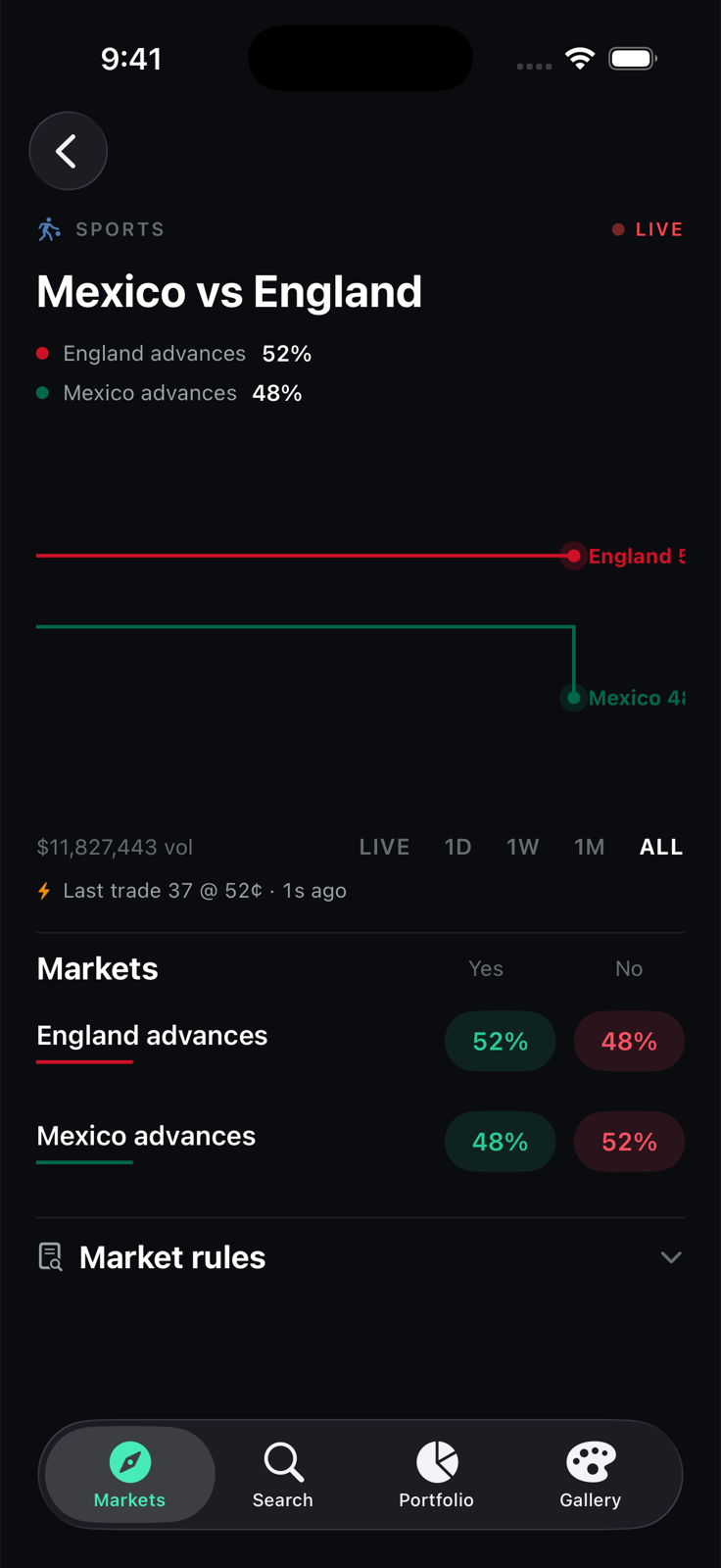
For a US sports trader the practical ranking is Kalshi first. Its NFL, NBA, and MLB books are the deepest in the category, it runs on Android and web as well as iPhone, and its taker fee on a mid-priced game contract is 1.75¢ against Polymarket US's 1.5¢, a gap the spread usually swamps. Polymarket's US app anchored its launch on sports and prices them a shade cheaper, but it is iOS-only and its books thin out away from headline games.
Two wrinkles before you fund anything. Sports is exactly the category tangled in state litigation, so check whether your state is on either venue's blocked list first; Minnesota has a ban taking effect August 1, 2026. And outside the US the question answers itself, since Kalshi is built for US residents and the international Polymarket's soccer books are excellent.
Is Kalshi or Polymarket better?#
People asking which is better, Kalshi or Polymarket, usually want one name. There isn't one; it depends on three things, each checkable in a few minutes.
What you trade. US sports and economics point to Kalshi, where the books are deepest. Politics, geopolitics, and crypto point to Polymarket: the international version if you are outside the US, the regulated app if you are inside. If you mostly trade geopolitical headlines, Polymarket international charges nothing on that category.
How you can access each one. Polymarket US is iOS-only as of July 2026. If you are on Android or want a desktop terminal, Kalshi is the one that runs there. State eligibility cuts both ways and changes monthly; each app checks your state at signup.
How you trade. Takers at mid prices pay less on Polymarket, about 14% less on the US app and roughly 40% less on international politics markets. Makers do fine everywhere: free on most Kalshi markets, free on Polymarket international, and paid a small rebate on Polymarket US. If you park cash between trades, Kalshi's interest on idle balances is the only yield among the three venues.
Our recommendation, since most readers of this site lean sports: Kalshi as the base account, with Polymarket US on the phone for politics and the fee edge.
Kalshi for US sports and economics. Polymarket for politics and world events. If you cannot decide, practice free first; the contract is the same on both.
Try the mechanics with fake money first#
The contract is identical on both venues: YES or NO priced between 1¢ and 99¢, settling at $1 or $0 when the event resolves. The skills transfer completely, which also means you can learn them without funding anyone. Neither platform gives you real practice. Kalshi's demo at demo.kalshi.co is a separate web sandbox with simulated order books that Kalshi's own docs warn may not reflect real markets; the Kalshi paper trading guide covers it. Polymarket has no demo at all on either version; the Polymarket paper trading guide covers your options there.
PaperPicks is the live-odds route: a free iPhone app that mirrors the same public prediction-market odds moving on the real exchanges and hands you a $100 paper bankroll. Prices are live probabilities, positions settle when the real markets resolve, and your P&L record is permanent, with no signup or KYC in the way. If the whole product is new to you, start with how prediction markets work first.
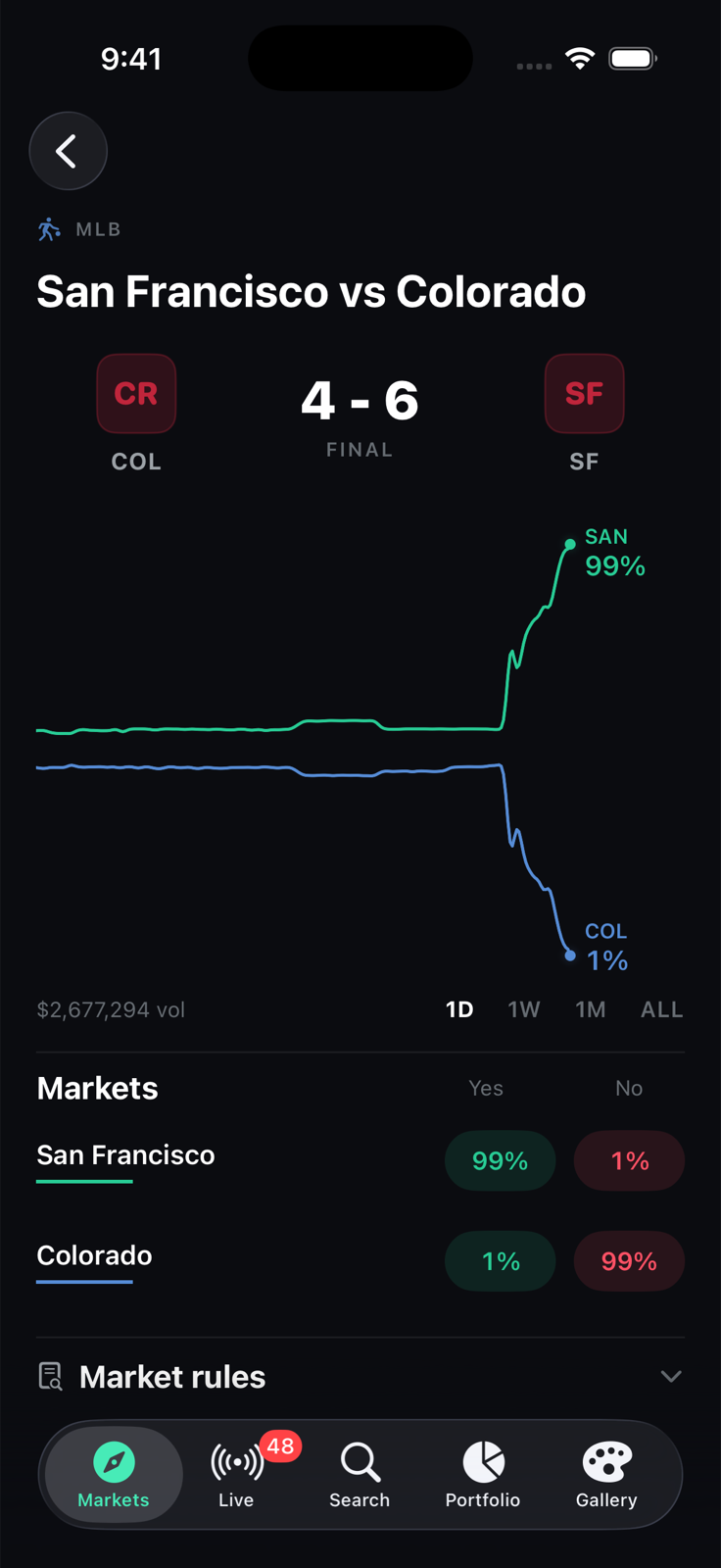
A few weeks there answers the question this page cannot: which catalog you are actually good at. Then fund the venue that matches your record instead of your guess.
- Kalshi fee schedule (PDF, effective July 7, 2026) — the current taker and maker formulas and per-product multiplier tables
- Polymarket US docs: fee schedule — US app taker fee, maker rebate, and volume tiers effective July 1, 2026
- Polymarket docs: trading fees (international) — category taker rates, free geopolitics markets, maker rebate program
- Covers: Polymarket removes waitlist for US iOS users — the May 12, 2026 open-signup date
- The Block: Kalshi and Polymarket volume surges to $45B in June — June 2026 volume split and the World Cup effect
- iPredicta: Is Polymarket available in the US? — the QCEX acquisition and the two-venue structure explained
Facts checked against primary sources on July 24, 2026.