 PaperPicks.
A prediction market is an exchange where people buy and sell contracts tied to the outcome of a future event, like an election, a game, or a Fed rate decision. Each contract pays $1 if the event happens and $0 if it does not, so the price, somewhere between 1¢ and 99¢, is the crowd's live estimate of the probability. You can practice the full loop free on PaperPicks, an iPhone paper trading app with live odds, no signup, and no real money.
What is a prediction market?#
A prediction market is an exchange where people buy and sell contracts tied to the outcome of a future event, like an election, a football game, or a Fed rate decision. Each contract pays $1 if the event happens and $0 if it does not, so the price it trades at, somewhere between 1¢ and 99¢, is the crowd's live estimate of the probability.
That second sentence is the whole trick. A stock price tells you what the market thinks a company is worth. A prediction market price tells you how likely the market thinks something is. When a contract on a September Fed cut trades at 24¢, the market is saying 24%.
The questions on offer are broader than most people expect: game winners and player props, elections and legislation, inflation prints and jobs numbers, Bitcoin price targets, box office totals, award shows. If a question has a verifiable answer and a deadline, an exchange can list it.
Event contracts: one question, two sides#
The instrument you trade is called an event contract. Every market is built on a single yes-or-no question with a deadline and published rules for what counts. "Will the Fed cut rates at the September meeting?" is a market. So is "Will the Chiefs win on Sunday?"
Each contract has two sides:
- YES pays $1.00 if the event happens, and nothing if it does not.
- NO pays $1.00 if the event does not happen, and nothing if it does.
The two sides mirror each other exactly. If YES trades at 24¢, NO trades at 76¢, because the pair always pays out exactly $1 between them. Buying NO at 76¢ is the same position as betting against YES at 24¢, just expressed from the other side. This mirroring is why one number describes the whole market: the probability that YES wins.
Notice what is missing: a house. Nobody at the exchange wrote that question hoping you lose. You are trading with another person who reads the world differently, and either of you can sell to somebody else before the question resolves.
How prediction market prices work#
Why does 24¢ mean 24%? Because the payout is fixed at $1. If a contract pays $1 when you are right, its fair price is exactly the chance of being right, so a 24% event is worth 24¢. Price and probability are the same number.
The market enforces this. If the price sags to 15¢ while the real chance is 24%, buying is profitable on average, and buyers push the price back up. If it overshoots to 40¢, sellers do the same in reverse. Thousands of self-interested traders grinding on that logic produce a number that updates within seconds of real news.
Who sets the price? Traders do, never the venue. The exchange runs an order book, the same machinery as a stock exchange, and it is simpler than it sounds. Buyers post bids, the most they will pay. Sellers post asks, the least they will accept. When a bid and an ask meet, a trade prints, and that print is the price you see on screen. The gap between the best bid and the best ask is called the spread, and it is the cost of trading right now instead of waiting for a better offer.
This structure is also why there is no vig hiding in the price. A sportsbook prices both sides of a game so the implied probabilities add up to more than 100%, and the overage is its margin, the vig. On a prediction market, YES and NO always sum to exactly $1, because they are halves of one contract. The venue earns trading fees instead, charged separately and different at every venue. The price itself stays a clean probability.
Prediction market prices are implied probability with no vig: 25¢ is +300, 50¢ is +100 (even money), 75¢ is -300. Once you think in cents, every odds format is easy; our guide to reading prediction market odds has the full conversion.
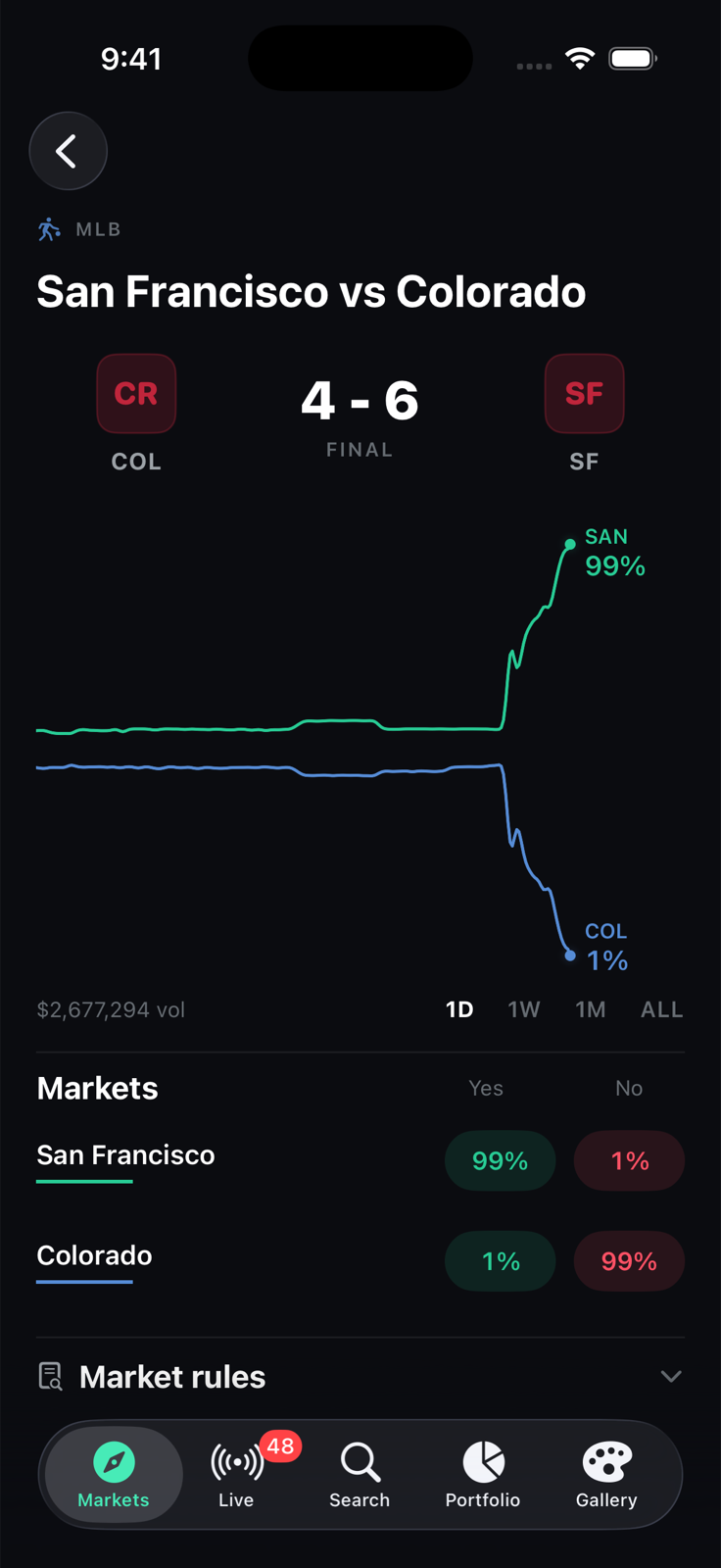
A market at 70% still loses three times in ten, so no single price proves anything. Across thousands of markets, though, prices track real-world frequencies better than pundits and usually better than polls; the full evidence, including the two known biases, is in are prediction markets accurate.
One full trade, start to finish#
Say it is July and the market "Will the Fed cut rates at the September meeting?" has YES trading at 24¢. You have read the inflation data and think the real chance is closer to 40%. To you the contract is cheap, so you buy.
You buy 50 YES contracts at 24¢ each, $12 total. That $12 is the most you can lose, and you knew it before you tapped buy. If the Fed cuts, your contracts pay $50.
Two weeks later a soft inflation report lands. Traders who read it the way you did start buying within minutes, and the price climbs from 24¢ to 41¢. Nothing about September is decided yet. The only thing that changed is the crowd's estimate, and the price moved because everyone acting on the news had to outbid everyone who doubted it. This is the part no article can quite convey: watching a probability breathe.
Now you have a choice a sportsbook never gives you. Sell the 50 contracts at 41¢ for $20.50 and lock in an $8.50 profit with no remaining risk, or hold to settlement and stay exposed to what the Fed actually does. A position in a prediction market is a live, tradeable thing, not a slip locked in a drawer.
Say you hold. In September the Fed announces a cut. The market resolves YES, each contract pays $1, and $50 lands in your account: $38 profit on $12 risked. If the Fed had held instead, your contracts would have expired worthless and NO holders would have collected the same pool.
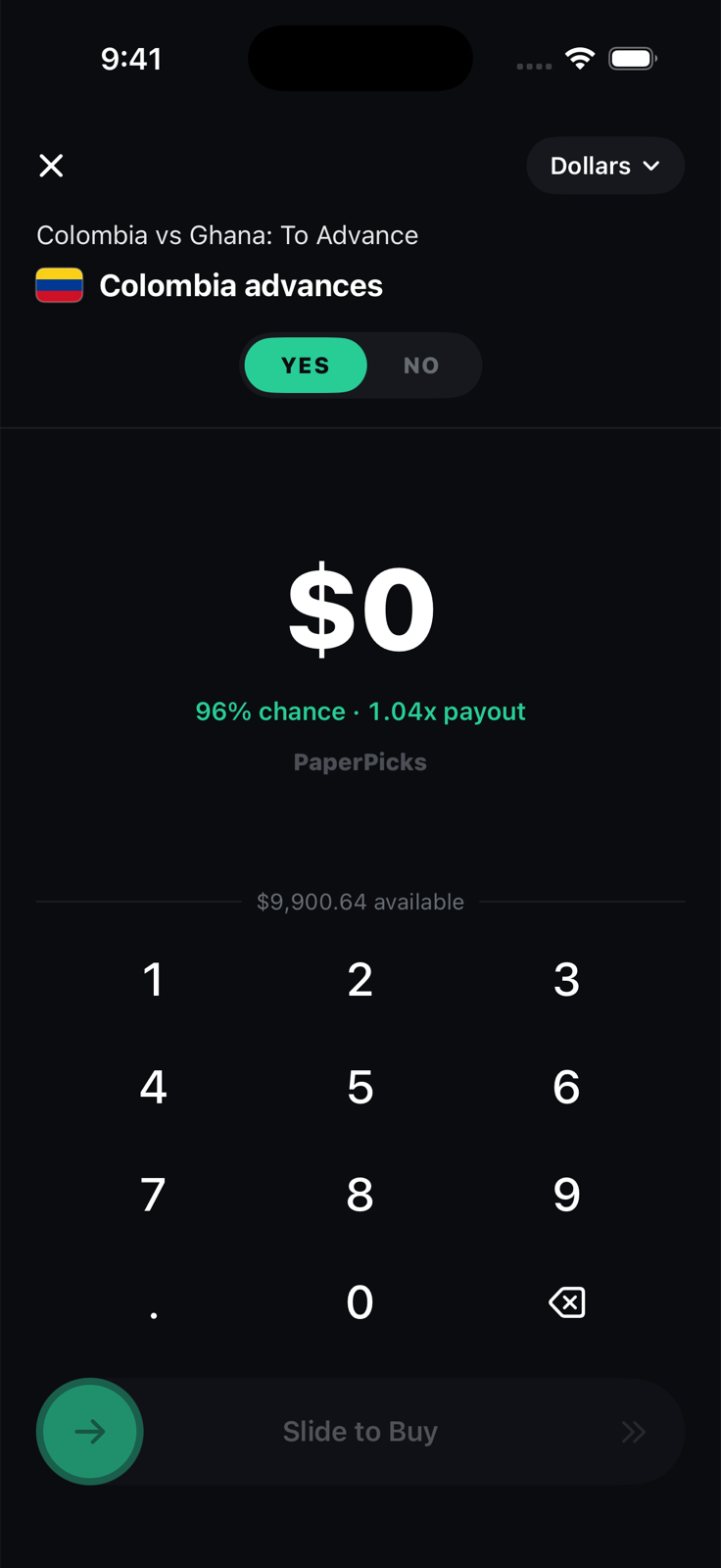
Prediction market settlement#
Settlement is the moment the question stops being a probability and becomes a fact. Every market publishes resolution rules up front: what exactly counts as YES, which source decides it, and when. A Fed market resolves on the Fed's own statement. A game market resolves on the league's official final score, and an inflation market on the number the Bureau of Labor Statistics prints, whatever commentators expected.
When the source publishes, the exchange resolves the market. Winning contracts pay $1 each, losing contracts pay nothing, and the money moves automatically. There is no claiming step and nobody to argue with.
The surprises live in the fine print. A market on "Team X wins" might count overtime, or not. A market on "player scores two or more goals" might exclude penalty shootouts. Two markets can ask what sounds like the same question and resolve differently because their rules name different sources. Traders who read the rules before the price keep more of their money, and it is a habit worth building while your money is fake.
Prediction markets explained in one table#
If you already know sportsbooks or the stock market, the fastest way to understand prediction markets is to place them between the two:
| Prediction market | Sportsbook | Stock market | |
|---|---|---|---|
| What you trade | Event contracts paying $1 or $0 | A bet against the house's line | Shares of a company |
| Who sets the price | Other traders, in an order book | The bookmaker, vig included | Other traders, in an order book |
| When it ends | At a set date, when the event resolves | When your bet settles | Whenever you sell |
| What decides the payout | Did the event happen, per written rules | The house grading your bet | What the next buyer will pay |
Read across the rows and the pattern is clear: a prediction market is stock-exchange machinery pointed at sportsbook questions, plus elections, economics, and everything else with a checkable answer.
Where you can trade prediction markets in 2026#
As of July 2026, a US trader has three regulated real-money venues and two free ways to practice.
Kalshi is a CFTC-regulated US exchange and has operated since 2021. Real money, dollar deposits, full identity verification. It lists sports, politics, economics, and culture, with deep books on the big questions.
Polymarket now has a regulated US arm as well. After acquiring the CFTC-registered exchange QCEX, it opened to US users in December 2025 behind an invite waitlist, then removed the waitlist on May 12, 2026. The US product is an iOS app with dollar funding and full KYC; Android and web versions have not shipped yet. The offshore Polymarket most people remember, the one running on USDC, is still geo-blocked for US residents, and reaching it through a VPN violates its terms.
Robinhood offers event contracts inside its main app through its derivatives arm, with contracts listed on CFTC-regulated partner exchanges. If you already have a Robinhood account it is the shortest path to a first real contract, though the catalog is smaller than on the dedicated exchanges.
Practice options. Kalshi runs a free web demo at demo.kalshi.co with mock funds, but it uses simulated order books that Kalshi itself warns may not reflect real markets; our Kalshi paper trading guide covers it in detail. To practice against live prices instead, PaperPicks paper trades the same public markets at real odds.
All three real-money venues require you to be 18 or older and to verify your identity before trading, and a few states restrict certain contract types, sports contracts especially.
Practice before you fund an account#
Everything above is how prediction markets work in principle. Doing it well is a separate skill: noticing when 24¢ is genuinely cheap, sizing a position you can afford to lose, holding through a price swing you did not expect. Those are reps, and reps are cheaper on paper.
PaperPicks is a free iPhone app that mirrors live public prediction market odds. You get a $100 paper bankroll and trade the same event contracts this guide describes, at the prices printing on real markets right now. When news moves the real market, your screen moves. When the real market settles, your position settles. There is no signup and no KYC, your record is permanent, and no real money is ever involved.
- Download PaperPicks from the App Store.
- Open it. An anonymous account is created for you, with nothing to fill in.
- Buy YES or NO on any live market and follow it through settlement.
A few weeks of honest paper results will tell you whether your read of the crowd is real. If you later step up to Kalshi or Polymarket with actual money, you will arrive already fluent.
- iPredicta: Is Polymarket available in the US? — the QCEX acquisition, the December 2025 US relaunch, and the offshore geo-block
- Covers: Polymarket removes waitlist for US iOS users — the May 12, 2026 waitlist removal
- Robinhood Support: Event contracts overview — how Robinhood offers event contracts and which states are restricted
- Kalshi docs: Test in the demo environment — the official demo and its simulated-books warning
Facts checked against primary sources on July 24, 2026.