 PaperPicks.
Yes, Kalshi has a demo: a separate web account at demo.kalshi.co with mock funds and simulated order books. Kalshi's own docs warn demo prices "may not be reflective" of real markets, and the main app has no practice mode. To practice against live prices, use a paper trading simulator like PaperPicks: free on iPhone, $100 fake bankroll, real market odds, no signup.
Does Kalshi have a demo account?#
Yes. Kalshi runs a demo environment at demo.kalshi.co with mock funds, and it has quietly become more usable over the past year. It started as a sandbox for developers testing bots against the API, and the docs still describe it that way. But there is now a consumer walkthrough in Kalshi's Help Center, and nothing stops a regular person from signing up and clicking around.
Setup takes a few minutes:
- Go to demo.kalshi.co and create an account. Credentials are separate from real Kalshi, so your production login will not work here.
- Kalshi's help article walks you through the signup, including test identity and funding details, since the demo mimics the real onboarding flow.
- Mock funds land in the account and you can place orders in a browser.
That is genuinely useful for one job: learning what the exchange interface feels like before you wire in real money. If that is all you need, use it.
The fine print that matters#
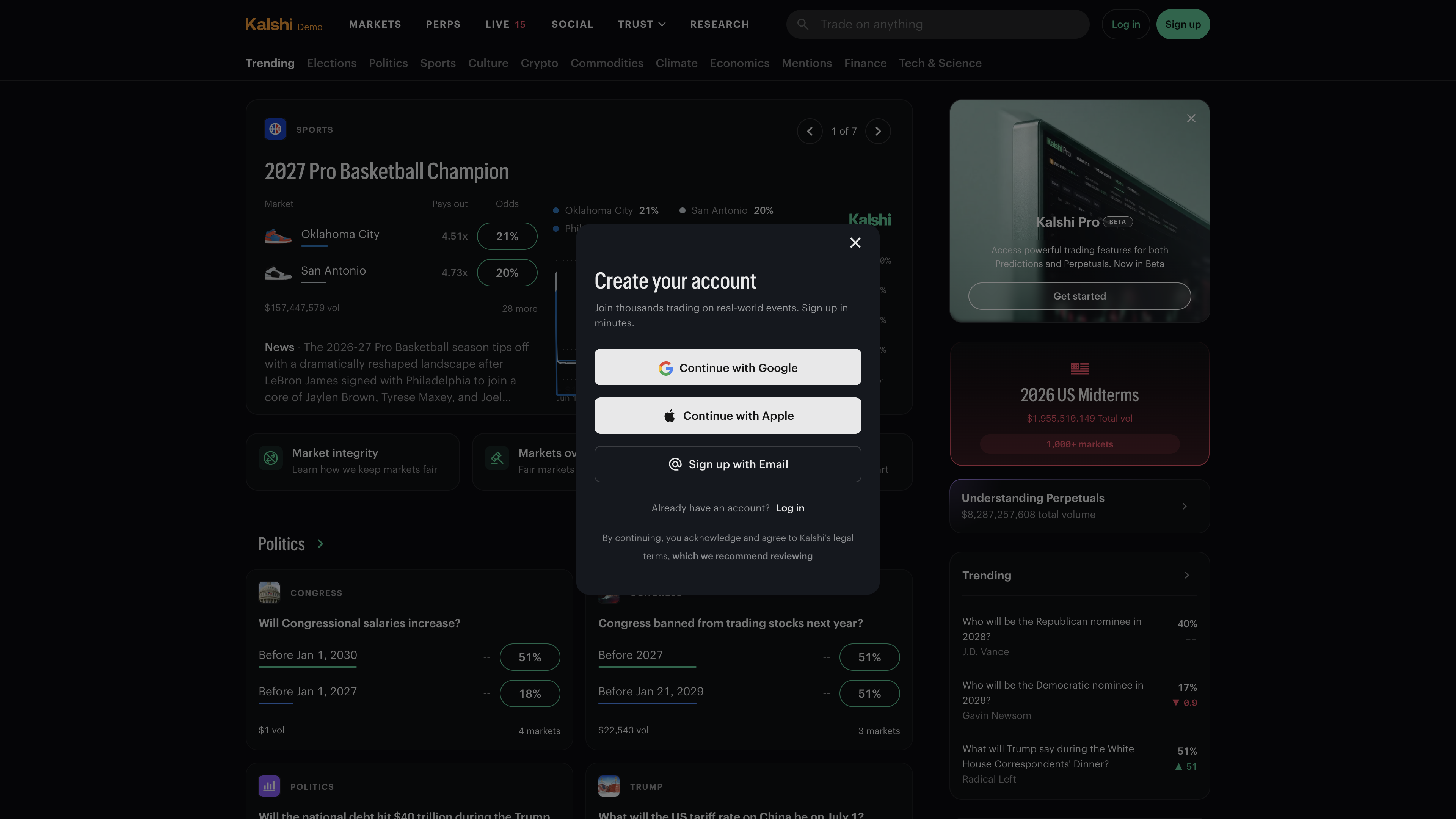
We signed up and poked around on July 24, 2026. The screenshot above is what you land on: a faithful copy of the Kalshi interface, with markets whose numbers quietly admit they are fake. One basketball event claims $157 million in demo volume while a congressional-salaries market two rows down has traded exactly $1. The freshest listing in the New column that day was "What will 1+1 equal on Jul 24 at 17:40?", which is a developer test market, not a trading opportunity.
None of that makes the demo useless. It makes it a rehearsal stage, and you should know that before drawing conclusions from anything that happens on it. Three limits matter:
The prices are not real. This is the big one, and it is Kalshi's own warning, not ours. The docs say the price and behavior of markets in the demo "may not be reflective of those in real markets." Demo books are thin and often stale. You can get filled at prices that would never print on the live exchange, and a strategy that works against a dead book can fall apart against a live one.
It lives outside the real app. The demo is a separate website with a separate account. Inside the main Kalshi iPhone app, every contract is real money, and getting there requires full identity verification because Kalshi is a CFTC-regulated exchange. There is no toggle to practice.
Nothing sticks. No permanent record, no leaderboard, nobody watching. That sounds trivial until you notice how differently you trade when your record follows you. A scratchpad invites scratchpad decisions.
Kalshi's demo is real and free, and it teaches the interface. It cannot teach you to read markets, because its prices are simulated. For that you need live odds.
Paper trade the same markets at live odds#
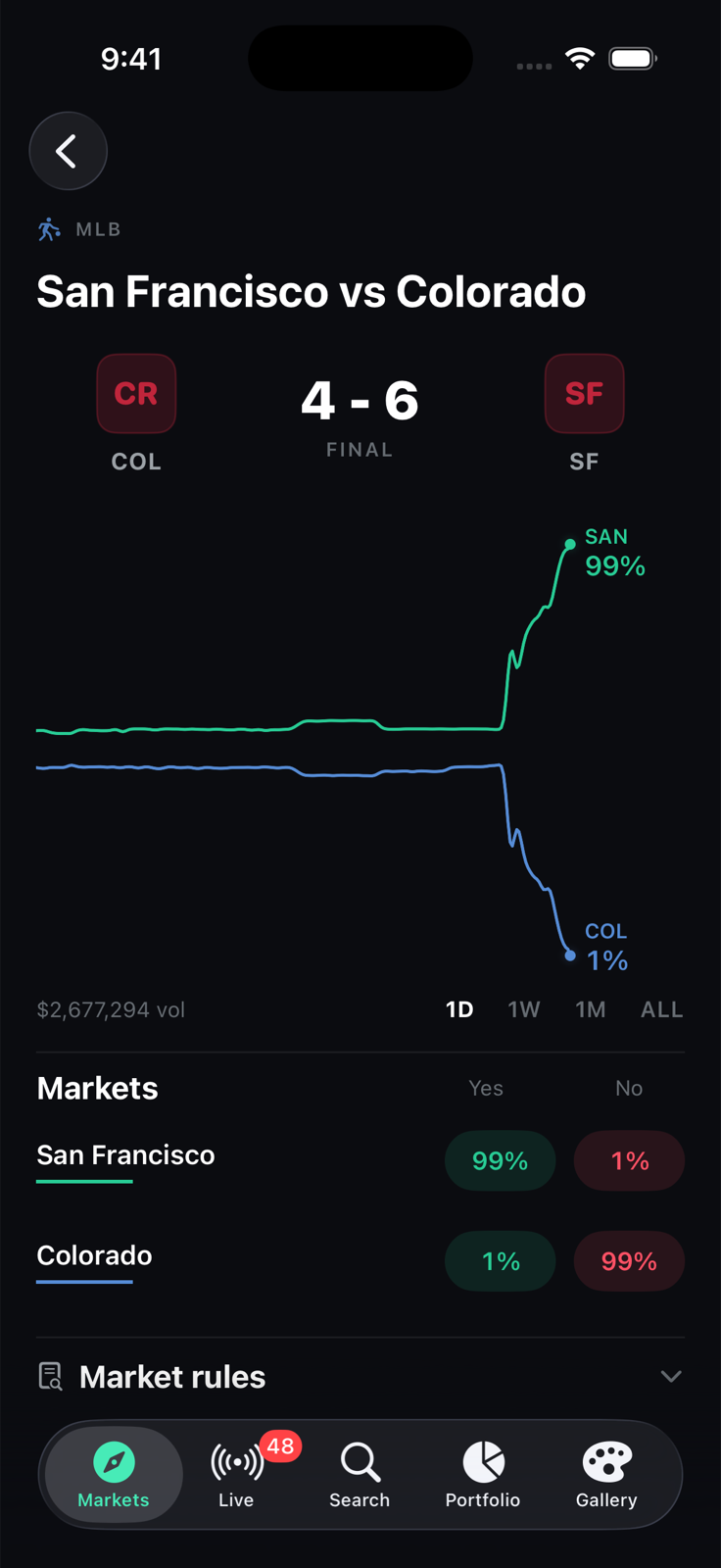
PaperPicks is a free iPhone app built for the judgment half of the problem. It mirrors live public prediction-market odds, the same event contracts real traders move on Kalshi: NFL and NBA games, elections, Fed decisions, Bitcoin price targets, award shows. You get a $100 paper bankroll and trade them at the prices that are actually printing.
The mechanics stay faithful to the real thing:
- Prices are live probabilities. A contract at 24¢ means the crowd puts a 24% chance on the outcome. When news breaks and the real market moves, your screen moves with it.
- Contracts settle at $1 or $0. Right pays a dollar, wrong pays nothing. Identical to settlement on the real exchange.
- Settlement is real. Positions resolve when the underlying markets resolve, and the payout lands as a push notification.
- No reset button. Your record is permanent, like a real trading account. The scarce $100 is deliberate: position sizing only matters when you can actually bust.
- Zero friction. No KYC, no email, no deposit. You are trading within about ten seconds of opening the app.
Kalshi demo vs. PaperPicks#
| Kalshi demo | PaperPicks | |
|---|---|---|
| Built for | API and bot testing, open to anyone | Learning to trade |
| Odds | Simulated books, may not match real markets | Live exchange odds |
| Sign-up | Separate demo account | None, anonymous |
| Platform | Web browser | Native iPhone app |
| Settlement | Mock | Real market resolution |
| Record | Nothing persists | Permanent P&L, leaderboards |
| Social | No | Follow friends, tail or fade picks |
| Cost | Free | Free |
If you are validating a trading bot before pointing it at production, use Kalshi's demo. That is what it exists for, and it does the job well. If you are a person learning to read markets, practice where the prices are real.
What paper trading actually teaches you#
Roughly three quarters of retail prediction-market traders lose money. Most of those losses are tuition, paid to learn lessons that paper trading teaches for free:
- Prices are probabilities, not opinions. Buying YES at 80¢ wins often and pays little. Buying at 20¢ pays big and usually loses. Internalizing expected value takes reps, not articles.
- Position sizing is survival. A $100 bankroll that can bust teaches sizing faster than any Kelly-criterion explainer. Going all-in on one 60/40 call feels great until it doesn't.
- Settlement risk is real. Markets resolve on precise rules, not vibes. Paper traders learn to read resolution criteria while mistakes are still free.
- Your record doesn't lie. PaperPicks scores P&L server-side with no resets. A month of honest paper results tells you whether you have an edge or an expensive hobby waiting to happen.
How to start (about 30 seconds)#
- Download PaperPicks from the App Store. Free, iPhone.
- Open it. An anonymous account is created automatically, with nothing to fill in.
- Pick any live market, tonight's game or the next Fed decision, and buy YES or NO with paper money.
- When the real market settles, so does your position. Grow the $100, or bust and learn why.
When your paper record says you are consistently sharp, not one hot week but a real sample, you will walk into any real-money venue knowing exactly what kind of trader you are. That is the entire point.
- Kalshi docs: Test in the demo environment — the official demo description and the market-realism warning
- Kalshi Help Center: Creating and using a demo account — consumer setup walkthrough
Facts checked against primary sources on July 24, 2026.