 PaperPicks.
Getting good is possible: calibration, position sizing, and specialization all respond to training. Tetlock's Good Judgment Project found a training module under an hour improved forecast accuracy 6 to 11% across four tournament years. Most traders never do the work: a 2026 WSJ analysis found more than 70% of Polymarket users lose money, and Kalshi counts 2.9 unprofitable users per profitable one. PaperPicks runs the practice loop free: live odds, a $100 paper bankroll, and a permanent record.
Who actually wins#
Start with the number the onboarding screens leave out. In May 2026 the Wall Street Journal analyzed 1.6 million Polymarket accounts and found that more than 70% of users have lost money, while 0.1% of accounts collected 67% of all profits. Kalshi told the Journal it counts 2.9 unprofitable users for every profitable one, about three in four losing. The typical Polymarket account is down between $1 and $100; the bottom tenth average $4,000 in losses.
The data is less depressing than it reads, because the losing is not mysterious. The winners the Journal profiled are mostly professionals running data feeds and algorithms. The typical loser is not losing to those sharks. They are losing to unforced errors: paying 80¢ for events that happen 65% of the time, betting a quarter of the roll on a "lock," spraying positions across categories they barely follow. Each error maps to a skill, and each skill trains.
So how to get good at prediction markets has a concrete answer: stop donating the way the losing 70% donate, and keep score until the record proves you have stopped.
The prediction market skills that actually train#
Whether forecasting improves with training has been tested harder than most trading questions ever get. Philip Tetlock's Good Judgment Project won the forecasting tournament run by IARPA, the US intelligence community's research agency, and produced the research behind the book Superforecasting. Two findings carry this page. A probability training module that took less than an hour, mostly base rates and belief updating, improved accuracy by 6 to 11% in each of four tournament years. And the skill was real rather than lucky: when the project promoted its top 2% of forecasters into elite "superforecaster" teams, they kept outperforming the next year instead of regressing to the mean.
That is the general answer to how to get good at forecasting: train calibration, keep score, practice inside a domain. A prediction market adds two more, because a market forecast also has to survive a price and a bankroll. The working set is four: calibration, sizing, specialization, and scorekeeping honest enough to measure the other three.
Calibration, explained in plain English#
A market price is a probability: a contract at 70¢ is the crowd calling a 70% chance, the whole five-minute foundation. Your edge, if you have one, is the gap between your probability and the market's. That only works if your probabilities mean something, and for most people they do not yet.
Calibration is the test. Take every forecast you have made at 80% confidence and check how many happened. Near 80%? You are calibrated there. Repeat at every level and plot it, stated confidence along the bottom, actual hit rate up the side. That plot is your calibration curve. A perfect forecaster's curve is the diagonal line. Nearly everyone's real curve sags below the diagonal at the top: events they call at 80% happen closer to 65% of the time. On a market, that sag has a price tag. Pay 80¢ for 65% events and you lose 15¢ a contract on average, forever, without ever feeling wrong.
The Good Judgment result is the encouraging part: an hour of training moved accuracy for a full year. The habits that do the work:
- Start from the base rate. Before the inside story ("this team looks unstoppable"), ask how often things like this happen. Favorites priced at 70¢ win about 70% of the time, because the markets themselves are well calibrated even when the people inside them are not.
- Update in small steps. One headline should nudge your number, not teleport it.
- Think in single percentage points. Choosing between 65% and 70% forces reasoning that "probably" lets you skip. The market quotes in cents; read the odds in cents too.
- Prefer fast-resolving markets while learning. Tonight's game grades your forecast tonight. An election market grades it in November. Feedback speed is learning speed.
Brier score explained#
The Brier score, introduced by meteorologist Glenn Brier in 1950, is the standard single number for forecast accuracy. For a yes-or-no event: take your forecast as a decimal, subtract the outcome (1 if it happened, 0 if it did not), and square the difference. Average across all your forecasts and that is your score.
One worked example. You forecast 70% that a team wins, and it wins: 0.7 minus 1 is -0.3, and -0.3 squared is 0.09. Had the team lost: 0.7 minus 0 is 0.7, squared is 0.49.
The benchmarks give those numbers meaning. Perfect foresight scores 0. Answering 50% to everything scores exactly 0.25 no matter what happens, so a score above 0.25 means a shrug would have beaten you. Saying 90% on something that does not happen costs 0.81. Confident wrongness is the most expensive habit in forecasting, and the squaring is how the score bills for it.
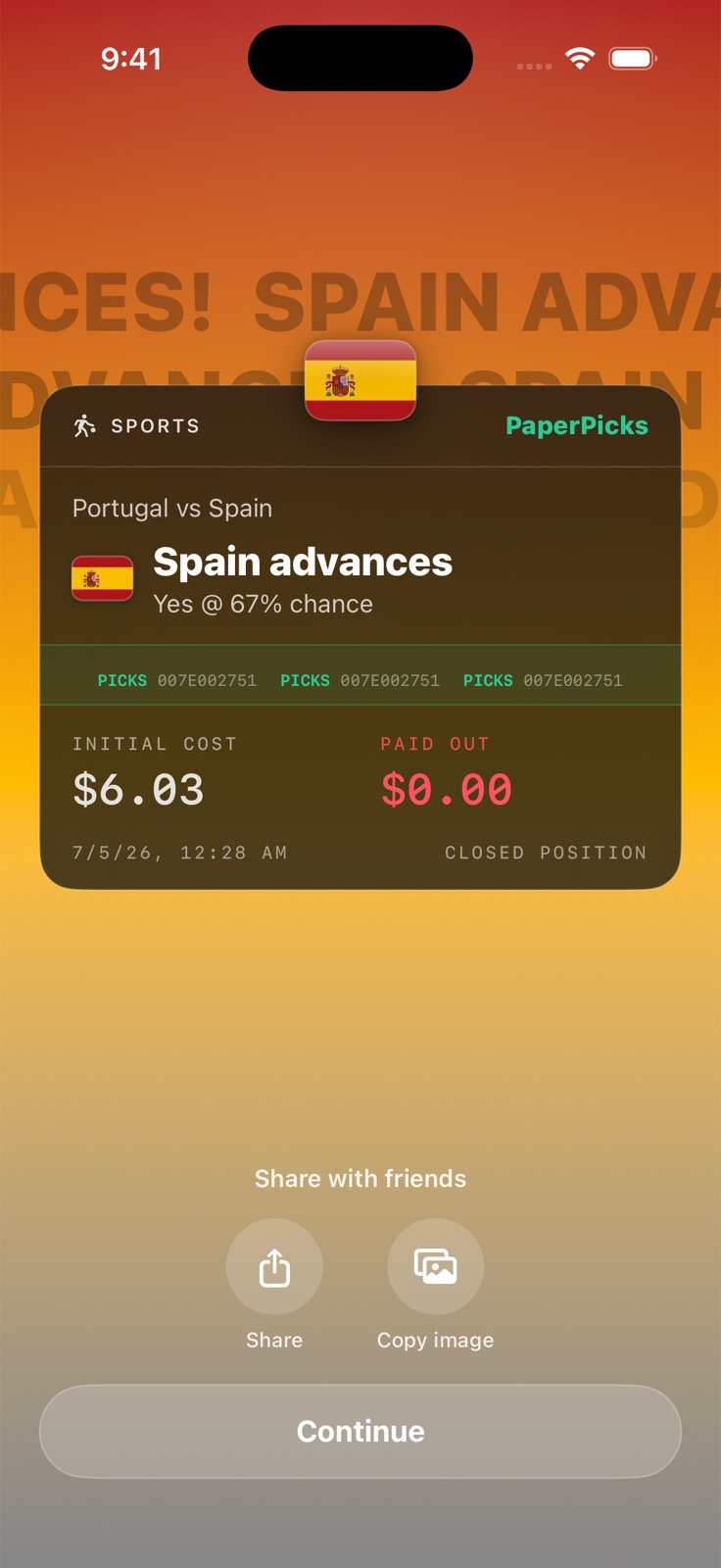
Every settled position is one graded forecast, with the price you paid as your stated confidence. A trading record doubles as a calibration dataset, provided it is honest.
Sizing: survive your own losing streaks#
Even good forecasters are wrong constantly. Win 60% of your trades, genuinely good on these markets, and you should still expect five straight losses about once per hundred trades. Position size decides whether that run is a bruise or a burial, and it is decided before any trade is placed.
The arithmetic is blunt. Risk 15% of your bankroll per position and five straight losses leaves 44% of the roll; getting back to even requires a 125% run. Cap positions at 5% and the same streak costs 23%, which one decent month can repair. Same forecasts, same luck, different survival. The formal tool is the Kelly criterion, which for realistic retail edges recommends low single digits of bankroll per trade; the bankroll management guide has the math. While learning, skip the formula and adopt the cap: nothing over 5%, no exceptions, because a 90¢ contract still misses one time in ten. The other classic bankroll killers are cataloged in prediction market mistakes.
Specialization: pick one lane#
An edge is knowing something the marginal price-setter does not. That is plausible in one domain you follow obsessively. It is not plausible across politics, crypto, the NBA, and the Oscars simultaneously. The Journal's winners fit the pattern: professionals working one lane with full-time attention, while casual money wanders category to category, paying the spread at every stop.
Kalshi's celebrity "mention markets" show what the tourist pays. The Journal analyzed 35,000 of them and found that bettors taking YES at the first price they see lose 11% of what they stake, a worse return than most Vegas slot machines. Those markets are not rigged. They are priced by people who model them better than the people clicking YES.
So pick the category you already know cold and stay in it until your record proves you can price it. For what edge inside a lane looks like, favorite-longshot bias and resolution-rule reading, see the strategies guide.
A record that cannot lie to you#
None of this trains without measurement, and in a domain this noisy, measurement needs a sample. Fifty to a hundred settled trades is a sensible floor before your P&L means much; below that, a hot month and a lucky month are the same month. The record also has to be honest. A record you can reset every time it embarrasses you is not a record. It is a mood.
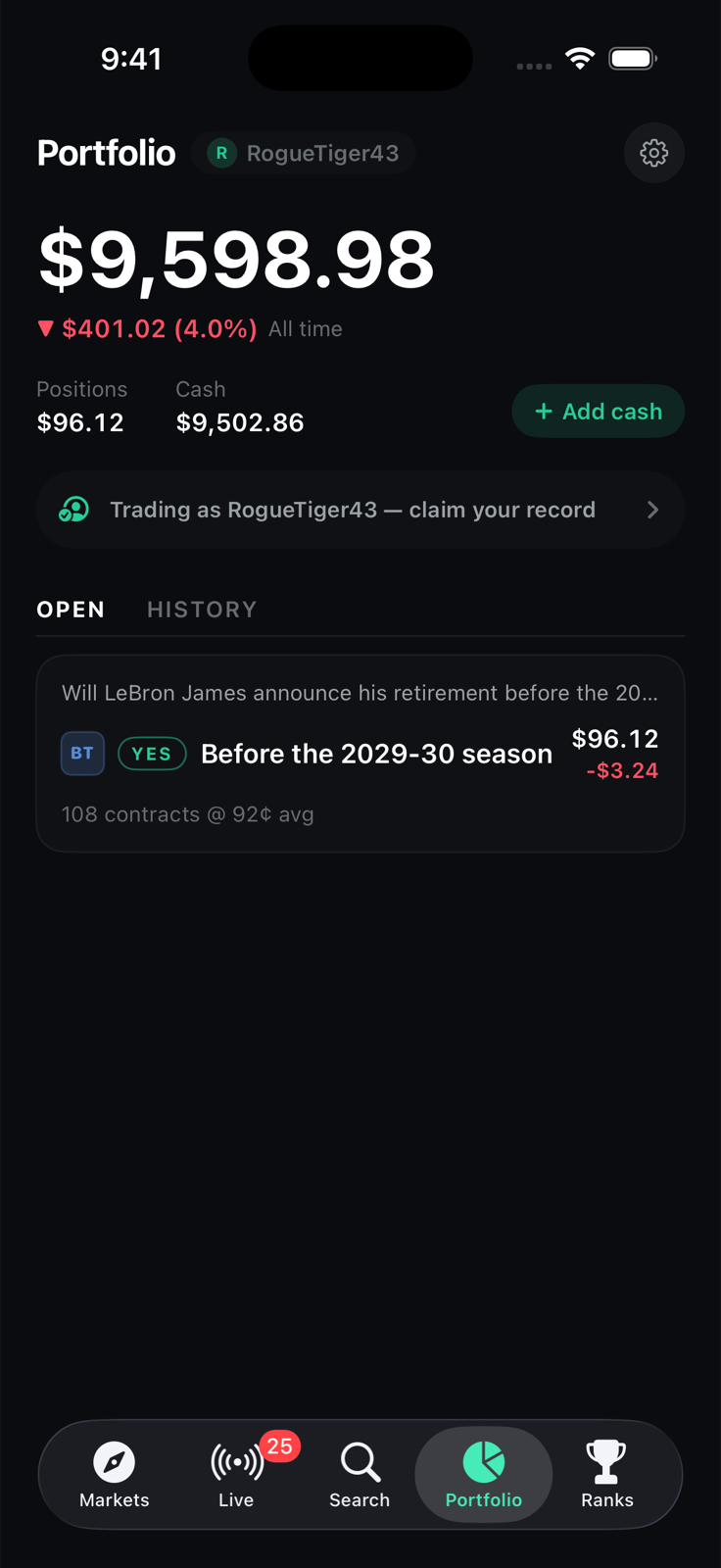
This is the step people skip, because honest scorekeeping is unpleasant and spreadsheets do not enforce themselves. A simulator built for practice can enforce it for you. PaperPicks is a free iPhone app built around this loop: live odds mirroring public prediction markets, real settlement when the underlying markets resolve, and a $100 paper bankroll scarce enough that sizing is a real decision. The record is scored server-side, permanent, and sits on leaderboards next to everyone else's. The social layer, following other players and tailing or fading their picks, mostly supplies witnesses. No signup, and no real money anywhere in the system.
A 30-day forecasting practice plan#
Thirty days of deliberate forecasting practice runs the whole loop and collects a first real sample. The plan assumes paper money and fast-resolving markets.
| Week | Focus | The work |
|---|---|---|
| 1 | Mechanics and a lane | Pick one category you already follow. Make 10 to 15 small positions in fast-resolving markets. Write your probability down before you look at the price. |
| 2 | Sizing | Keep forecasting, but enforce the 5% cap and vary size with conviction: more on your strongest reads, less on coin flips. |
| 3 | Review | Trade only your category. Reread the resolution rules on everything you hold. Write one sentence on each of your three worst losses: what you knew versus what you hoped. |
| 4 | Audit | Bucket every settled forecast by stated confidence and check each bucket's hit rate. Compute your Brier score. Compare every position size to the cap. |
Week 1 hides the most important instruction: write your number down before you see the market's. That is the only way to learn whether you have opinions or just reactions, and the gap between the two numbers is your first calibration data. By the audit you will have 40 to 60 settled forecasts and a baseline: your curve, your score, your worst habit. A baseline, not a verdict. Most first audits show the classic pair, overconfident top buckets and oversized losers, the same lesson the Journal's bottom tenth paid $4,000 apiece to learn. On paper it costs a month of attention.
What does not improve with practice#
Three things, and pretending otherwise would undercut everything above.
The fear of real money. Paper cannot simulate what losing actual dollars feels like, and the feeling degrades decisions in ways practice does not fix. Paper separates your judgment errors from your emotional ones, so if you ever trade real money you know which mistakes are new.
Speed. The sharks at the top of the Journal's analysis run algorithms that reprice faster than you can read. No amount of practice out-clicks a bot. That is fine. Their game is speed on the deepest markets; a person's plausible edge is judgment in a lane the bots are not modeling closely.
Variance. A trained forecaster with a real edge still loses two trades in five. Practice shrinks the unforced errors; it does not repeal luck, and a plan that requires winning streaks was never a plan.
What practice buys is narrower and worth more: percentages that mean something, sizes that survive, a lane you actually know, and a record you can show someone without explaining anything away. The losing 70% pay tuition in dollars for those lessons. Paper charges attention.
- Wall Street Journal (May 2026): Why almost everyone loses on prediction markets, except a few sharks — loss rates and profit concentration on Polymarket and Kalshi
- Chang, Chen, Mellers, and Tetlock (2016), Judgment and Decision Making: Developing expert political judgment — the under-an-hour training module that improved accuracy 6 to 11% across four tournament years
- Mellers et al. (2014), Psychological Science: Psychological strategies for winning a geopolitical forecasting tournament — training, teaming, and tracking; the top 2% kept outperforming with no regression to the mean
Facts checked against primary sources on July 24, 2026.