 PaperPicks.
A standard -110/-110 sportsbook line hides about 4.55% hold inside the price; an event contract's YES and NO sum to $1.00, and the venue charges explicit trading fees instead, which usually cost less. Exchanges also let you sell out of a position mid-game and do not limit winners, which is why price-sensitive straight bettors tend to move. Sportsbooks still win on parlays, promos, and player prop depth, and if that is your game, stay.
What no vig actually means#
Every sportsbook price carries the house margin inside it. The standard line is -110 on both sides: risk $110 to win $100, whichever team you take. Convert that to implied probability and each side costs 110/210, or 52.38%. Add the two sides of the same game and the book is quoting 104.76% on an event with two outcomes. The extra 4.76 points are the vig.
What it costs is easiest to see if you bet both sides. Stake $110 on each team and you have paid $220 to collect exactly $210 no matter who wins. The book keeps $10 of your $220, which is 4.55%, for matching you with yourself. That hold sits inside every price on the board, and devigging exists to strip it back out and recover the fair number underneath.
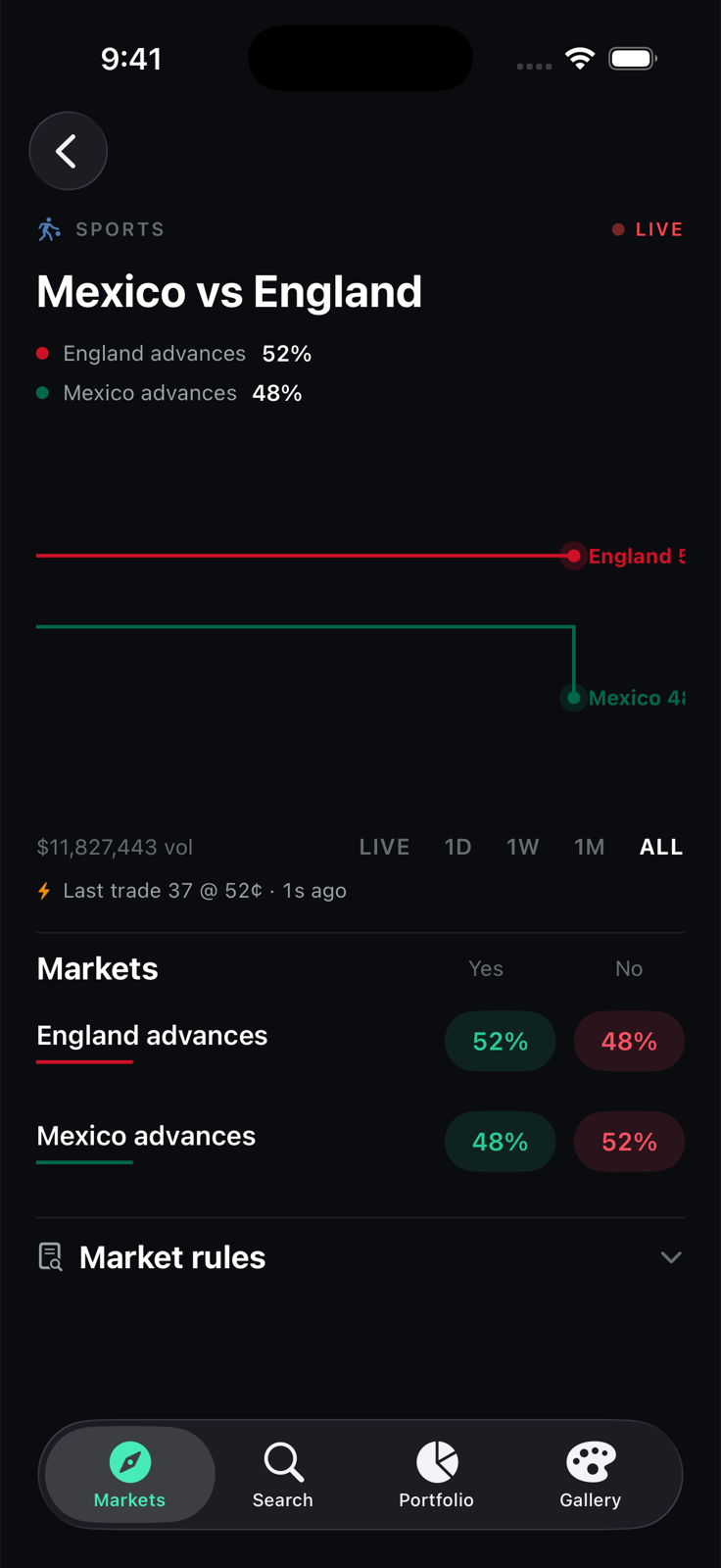
An event contract never puts it in. Contracts trade in cents, YES against NO, and the two prices sum to $1.00: a market at 52¢/48¢ is claiming 52% and 48%, a complete probability and nothing else. That is the whole meaning of no vig. The price is the crowd's estimate, not the crowd's estimate plus a margin. It does not make trading free: the venue takes its cut in the open, as a trading fee plus the bid-ask spread you cross to get filled immediately.
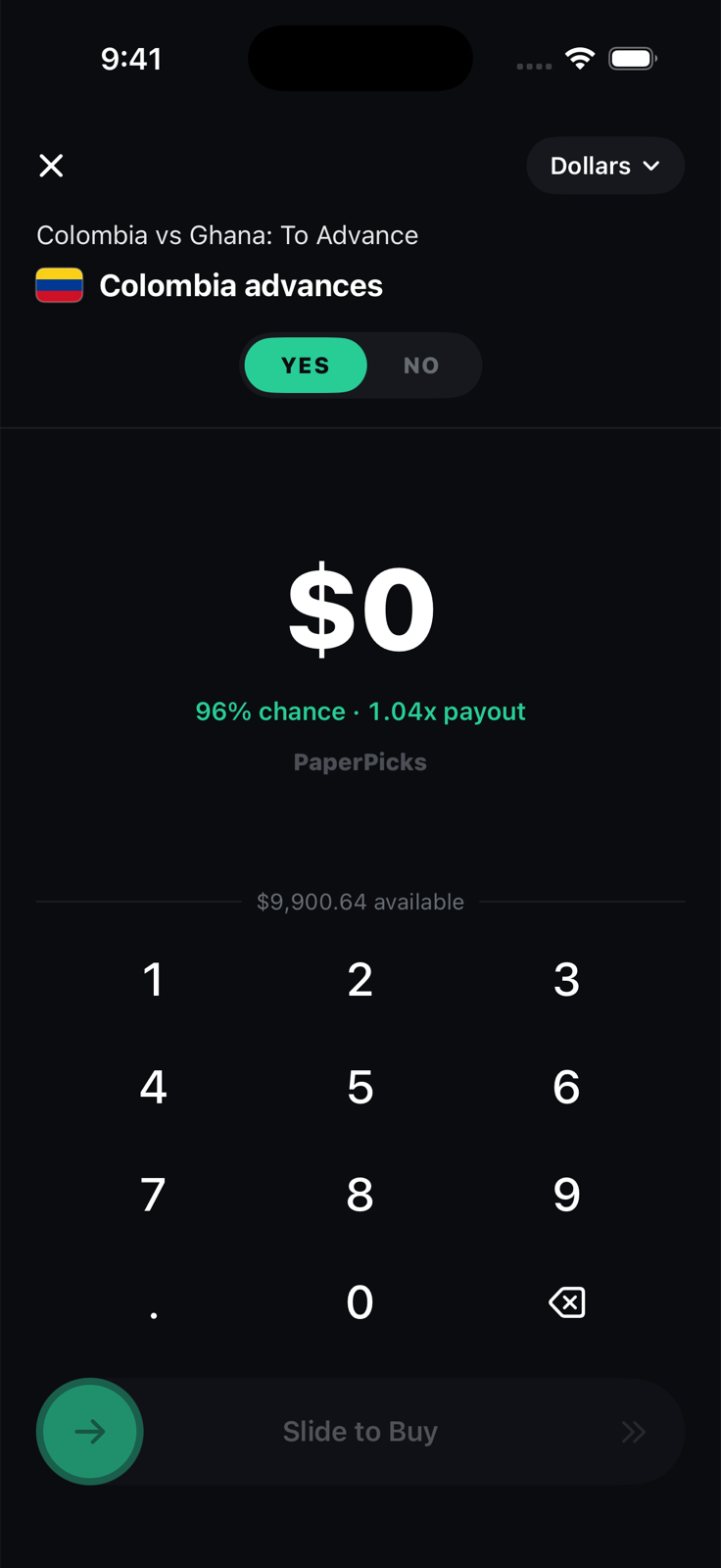
Fees deserve exact numbers, so here are Kalshi's, which have been product-dependent since the July 7, 2026 schedule. The general taker fee is 0.07 times contracts, times price, times one minus price, rounded up, with a per-product multiplier that defaults to 1. The formula peaks at even odds and shrinks toward the extremes: $1.75 per 100 contracts at 50¢, but only $0.27 per 100 contracts at 96¢. Resting limit orders pay a maker fee whose multiplier defaults to zero, so patient orders in most markets currently trade free.
Now run a $100 coin flip through both machines. At the book, $100 at -110 pays $90.91 when it wins, since the win pays 100 times 100/110. Half the time you hold $190.91 and half the time nothing, so the average outcome is $95.45 against $100 staked: the flip costs you $4.55 in expectation. On the exchange, $100 buys 200 contracts at 50¢, and the taker fee is 0.07 times 200 times 0.50 times 0.50, which is $3.50. You are in for $103.50 to collect $200 when you are right, an average outcome of $100 against $103.50 spent: $3.50 in expectation, at the worst price on the fee curve. The same position built with a resting order would have cost nothing but the wait.
At -110 you pay 52.38¢ per dollar of payout for a coin flip worth 50¢. On the exchange the same flip costs 50¢ plus at most 1.75¢ in fees. Both venues get paid. Only one shows you the bill.
The fee arithmetic above skips one cost: the spread. On a liquid game market it is a cent wide and irrelevant. On a thin market it can cost more than the vig you came here to escape, so look at the book depth before congratulating yourself.
Event contracts vs sports betting, side by side#
Every row in this table follows from one structural fact: the book is your counterparty, and the exchange is a venue. A sportsbook sets a price, takes your action against its own money, and manages the risk of being wrong about you. An exchange is a peer to peer betting exchange in the literal sense: your YES at 40¢ fills against someone else's NO at 60¢, the operator collects its fee from the match, and whether you win is a matter of complete indifference to it.
| Sportsbook | Prediction market | |
|---|---|---|
| Who sets the price | The house trading desk | Other traders, order by order |
| Vig or fees | About 4.55% hold inside a -110/-110 line | No vig in the price; explicit per-trade fees |
| Exiting early | Locked, unless the book offers a cash-out at its price | Sell at the live market price anytime |
| Winning too much | Limits shrink, then the account closes | Nothing happens; sharp volume is still volume |
| Line shopping | Essential; every book hangs its own number | One shared order book per venue; you can post your own bid |
| Regulation | State-licensed gambling, state by state | CFTC-regulated derivatives, contested by several states |
A book that loses to you will eventually stop dealing with you. A venue that only matches you cannot lose to you, which is why the fourth row is the difference sharp bettors mention first.
Trading out of positions#
A sportsbook ticket is locked from acceptance until it grades. Cash-out looks like an exit, but read how the offer is built: the book reprices your ticket at its current line, then applies margin against you a second time. You are selling back to the counterparty that sold to you, at its price.
An event contract is a position in the ordinary trading sense, and trading out of positions is not a feature. It is just what an order book does. Buy Chiefs YES at 40¢, watch them go up 14 by halftime, and sell at 78¢ for a 38¢ profit per contract without sweating a fourth quarter collapse. Or watch your reason die, the star rolls an ankle, and get out at 31¢ instead of riding a dead thesis to zero.
That one mechanic changes strategy more than the vig does. A bet is one decision graded once. A position is a stream of decisions, where being early matters about as much as being right: you can take profit when the move you predicted arrives before the final whistle, hedge a pregame entry with an in-play exit, or be wrong at 40¢ and still salvage 30 of it, which over a season is the difference between a drawdown and a disaster. Two costs stay attached. Selling is a trade, so it pays the fee again where one applies, and exits need liquidity, since selling into a thin book means crossing a wide spread.
Line shopping, limits, and closing line value#
Sharp sportsbook betting is account logistics as much as handicapping. Line shopping means holding funded accounts at five or six books, because each desk hangs its own number and half a point of difference compounds over a season. It also means managing your own reputation, since winning against the close is exactly what book risk teams screen for: bet too well and the limits arrive, first on props, then everywhere. On an exchange the venue holds no position against you, so the winning that gets a sportsbook account closed just makes you a bigger customer.
Closing line value is the yardstick underneath all of this. The closing price is the market's best estimate, with every injury report and every sharp dollar already in it, so entries that consistently beat the close indicate edge regardless of last month's results, and entries that do not suggest your profits are variance wearing a costume. Pinnacle, the book sharps benchmark against, keeps a plain-language explainer of the metric on its own site. The discipline transfers to event contracts whole and gets easier to practice: your entry and the close are both probabilities already, so buying at 40¢ on a market that closes at 46¢ is six points of closing line value, with no devig step.
Line shopping flips rather than disappears. There is one shared order book per venue; shopping happens between venues, Kalshi against Polymarket, and inside the book itself. If the ask is 52¢ and the bid is 51¢, post 51¢ and let an impatient seller come to you, earning the spread instead of paying it. A sportsbook counter never negotiates.
The regulation, in one paragraph#
A sportsbook is state-licensed gambling: each state decides whether to allow it, licenses the operators, and taxes the handle, which is why the app that works in New Jersey does not work in Texas. Kalshi-style event contracts run under federal law instead, as derivatives listed on exchanges the CFTC designates, which is why one account works nationwide. Several states dispute that sports contracts belong there and have issued cease-and-desist orders calling them unlicensed sports betting. The courts have sided with the exchanges so far, but not finally: in April 2026 the Third Circuit upheld a preliminary injunction stopping New Jersey from enforcing its gambling laws against Kalshi's sports contracts, while parallel cases were still pending in the Fourth, Sixth, and Ninth Circuits and New Jersey weighed a Supreme Court petition. If your plans depend on event contracts staying available in your state, treat that as open, not settled.
Kalshi vs sportsbook: who should use which#
The disclosure first: PaperPicks has no affiliate relationship with any sportsbook or exchange, so this page earns the same whichever way you go, which is nothing.
Stay with the sportsbook if the products you enjoy are sportsbook products. Parlays and same-game parlays are the book's invention, and whatever combo products exchanges list, the menus are thin next to a book's. Promos are real money if you work them; a disciplined bettor extracts genuine value from boosts and bonus bets. Player prop depth at a mature book still beats exchange menus outside headline games. And if you bet $20 recreationally, limits will never touch you, so the exchange's biggest structural gift is one you would never open.
Move, or at least split your action, if you bet straight sides and totals with any price sensitivity. The hold math from the top of this page compounds: 4.55 cents of expected loss per dollar at the book, against posted fees that top out around 3.5 cents per dollar of position and fall from there. If you have ever been limited, the case makes itself. Same if the thing you want most is the exit, because books do not sell your ticket back at a fair price, and exchanges do nothing else all day. Kalshi also lists markets no book will hang a line on: elections, Fed decisions, inflation prints, award shows.
So the direct answer on kalshi vs sportsbook: the venues are good at different jobs, and the bettors who do best treat them that way. Promos and props where the book is generous. Straight prices and exits where the exchange is honest.
Practice the exchange mechanics free#
The concepts above take an afternoon. The reflexes take reps: reading 80¢ as an 80% claim instead of translating it to -400, sizing a position when the downside is the whole stake, selling into strength instead of watching a profit evaporate. Building those habits with rent money is how tuition gets paid.
PaperPicks makes the reps free. It is a free iPhone prediction market simulator: a $100 paper bankroll, live odds mirroring the same public event contracts real traders move, real settlement when the underlying markets resolve, no signup, and a permanent record that shows whether your entries beat the close. No real money ever enters or leaves. Download it, find tonight's game priced in cents, and run the number you would have bet at the book through the exchange machine instead. If your edge survives the translation, you will know exactly what to do with that information. If it does not, the lesson was free.
- Kalshi fee schedule (July 7, 2026 update) — the taker and maker fee formulas used in the arithmetic
- Pinnacle: What is closing line value (CLV) in sports betting? — a sharp book explaining the yardstick in its own words
- The Guardian: New Jersey cannot regulate Kalshi's prediction market, court rules — the April 2026 Third Circuit ruling
- Holland & Knight: CFTC jurisdiction over sports event contracts likely exclusive — legal analysis, including the parallel cases pending in other circuits
Facts checked against primary sources on July 24, 2026.