 PaperPicks.
The price is the probability: a YES contract at 64¢ means the market currently gives the event a 64% chance. It pays $1.00 if you are right (36¢ profit on 64¢ risked, a 56% return) and $0 if you are wrong, while NO at 36¢ is the same market read from the other side.
Prediction market odds explained#
Every prediction market contract asks one yes-or-no question. Will the Chiefs win on Sunday? Will the Fed cut rates in September? The contract trades at a price between 1¢ and 99¢, and when the question resolves, each contract settles at exactly $1.00 if the answer was yes and $0 if it was no.
The price is not a fee or a rating. It is a live probability. A YES contract at 64¢ means the market currently puts a 64% chance on the event happening. Nobody sets that number. It is where the most recent buyer and seller agreed, and it moves as they change their minds.
Here is the 64¢ contract worked in full:
- One YES contract costs 64¢. That is also your maximum loss.
- If the event happens, the contract settles at $1.00. Profit: 100¢ - 64¢ = 36¢.
- 36¢ won on 64¢ risked is a 56% return, since 0.36 ÷ 0.64 = 0.5625.
- If the event misses, the contract settles at $0 and the 64¢ is gone.
Ten contracts scale everything by ten: $6.40 risked, $10.00 back if right, $3.60 profit. Cheap contracts pay big and usually lose. Expensive contracts win often and pay little. Neither is a bargain by default; a 20¢ contract is only good value if the true chance is better than 20%. If contracts and settlement are new to you, start with how prediction markets work.
Cents to probability: the implied probability formula#
The formula is short enough to feel like a joke:
implied probability in percent = price in cents
A 64¢ contract implies 64%. A 7¢ contract implies 7%. If you want a decimal instead, divide the price by the $1.00 payout: $0.64 ÷ $1.00 = 0.64. That one line is prediction market prices explained; everything else in this guide is bookkeeping around it.
The formula also runs in reverse when you have an opinion. If you believe an event is 40% likely, your fair price is 40¢. Below that, the contract is cheap to you. Above it, expensive. Every trade you will ever place on one of these markets is that comparison and nothing more.
Price in cents equals implied probability in percent. A 64¢ contract says 64%, pays $1.00 if right, and costs you the 64¢ if wrong.
YES and NO mirror each other#
Every market is two prices joined at the hip. The NO price is $1.00 minus the YES price, give or take a spread, because exactly one of the two sides will be worth $1.00 at settlement. If YES trades at 64¢, NO trades near 36¢.
The NO side has its own arithmetic. Buying NO at 36¢ risks 36¢ to win 64¢, a 178% return, since 0.64 ÷ 0.36 = 1.78. It is the identical position to selling YES at 64¢, written the other way around.
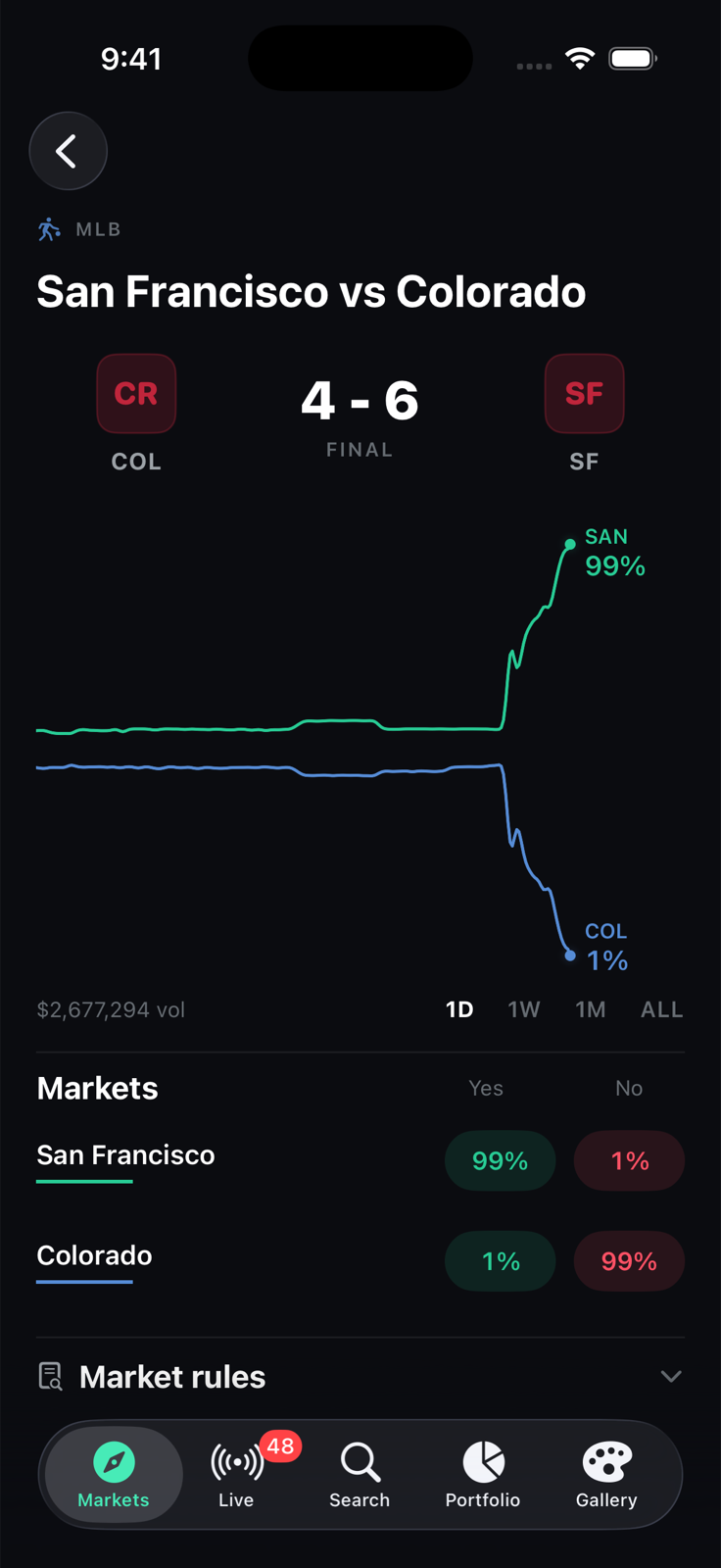
The screenshot above shows the mirror at its most extreme. The game is final, San Francisco won, and the board reads 99% and 1%: San Francisco YES costs 99¢ while Colorado YES costs 1¢. There is no house anywhere in that picture. Every contract exists because another trader took the opposite side at the same price. The exchange matches orders and holds the money. It does not care who wins.
How to convert prediction market prices to American odds#
If you grew up on sportsbooks, translate the price once and the screen stops looking foreign. Write the probability as a decimal first, so 64¢ means p = 0.64.
For favorites, priced above 50¢:
American odds = -100 × p ÷ (1 - p)
At 64¢ that is -100 × 0.64 ÷ 0.36 = -177.78, which rounds to -178.
For underdogs, priced below 50¢:
American odds = +100 × (1 - p) ÷ p
At 36¢ that is +100 × 0.64 ÷ 0.36 = +177.78, or +178. A 50¢ contract is even money, +100.
The reverse direction takes odds back to a probability:
- Negative odds: probability = odds ÷ (odds + 100), ignoring the sign. For -178: 178 ÷ 278 = 0.64.
- Positive odds: probability = 100 ÷ (odds + 100). For +178: 100 ÷ 278 = 0.36.
Decimal odds, the default format outside the US, are the easiest of the three. Decimal odds = 1 ÷ p, and back again: p = 1 ÷ decimal odds. A 64¢ contract is 1 ÷ 0.64 = 1.5625, displayed as 1.56.
| Price | Implied probability | American odds | Decimal odds |
|---|---|---|---|
| 5¢ | 5% | +1900 | 20.00 |
| 10¢ | 10% | +900 | 10.00 |
| 20¢ | 20% | +400 | 5.00 |
| 25¢ | 25% | +300 | 4.00 |
| 36¢ | 36% | +178 | 2.78 |
| 50¢ | 50% | +100 | 2.00 |
| 64¢ | 64% | -178 | 1.56 |
| 75¢ | 75% | -300 | 1.33 |
| 80¢ | 80% | -400 | 1.25 |
| 90¢ | 90% | -900 | 1.11 |
| 95¢ | 95% | -1900 | 1.05 |
American odds are rounded to the nearest whole number; the exact values at 36¢ and 64¢ are +177.78 and -177.78, and every other row is exact. Decimal odds are rounded to two places.
One difference hides behind the notation. A sportsbook line carries vig and an exchange price does not. A standard -110/-110 line implies 52.4% on each side, 104.8% in total, and the extra 4.8 points are the book's margin. On an exchange, YES at 64¢ and NO at 36¢ sum to exactly $1.00. The full comparison is in prediction markets vs sports betting.
How much to trust the number#
Two markets can both read 64¢ and deserve different amounts of respect. A 64¢ price with $2 million traded is thousands of people backing an estimate with money. A 64¢ price on $50 of volume might be two people and a guess. Thin books drift on any order of size, and they quote spreads wide enough to eat an entire edge.
One calibration caveat survives even in deep markets: below roughly 10¢, contracts tend to overstate the true probability. Longshots are systematically a little overpriced, which is worth remembering before a 4¢ moonshot starts looking clever. The evidence on pricing accuracy is collected in are prediction markets accurate.
What the bid-ask spread costs you#
The quoted price is really three numbers:
- The bid is the highest price any buyer will pay right now. Sell instantly and this is what you get.
- The ask is the lowest price any seller will take. Buy instantly and this is what you pay.
- The last is the most recent trade. It is history, not an offer.
The gap between bid and ask is the spread, and the spread is what impatience costs.
Work one example. A thin market shows bid 61¢, ask 65¢. The midpoint, the market's actual best guess, is 63¢. You market-buy 25 contracts and fill at the 65¢ ask, paying $16.25. The moment the order fills, the position's resale value is the 61¢ bid, or $15.25. You are down $1.00, about 6% of your stake, before the probability has moved at all. Worse, you now need the true chance to be 65% just to break even at settlement, in a market that itself only claims 63%.
Deep markets, elections and marquee games, often quote 1¢ spreads, and crossing costs almost nothing. Thin markets sit 5¢ or 10¢ wide, and a market order there starts you several points underwater. The fix is a limit order at or near the midpoint. You risk never getting filled, and in exchange you stop paying the spread and occasionally earn it. Ignoring the spread is the cheapest beginner mistake to cure.
The bid matters even if you never plan to sell early, because it is your exit. A contract bought at 24¢ that climbs to 58¢ can be sold at the bid right there, banking the move without waiting for settlement. Positions on these markets are live the whole way through.
Expected value, in one worked example#
You have a trade only when your probability disagrees with the market's. The measure of that disagreement:
EV per contract = (your probability × $1.00) - price
Suppose you have done the work on a game and honestly believe YES is 70% likely, while the market prices it at 64¢. EV = 0.70 × $1.00 - $0.64 = +6¢ per contract. Buy 100 contracts for $64 and your average result is about $6 of profit. Every part of that sentence leans on your 70% actually being right, and calibrating your own probabilities is the hard skill. The arithmetic is the easy one.
The 6¢ is also gross, not net. If you crossed a spread to enter, part of it is already spent. And these are venue prices: a real exchange like Kalshi charges trading fees on top, per its fee schedule, so your realized edge is smaller than the raw EV. Small gross edges routinely net out to nothing. How much to stake on the edges that survive is a separate question, covered in bankroll management.
Practice reading prices with paper money#
All of the above fits on an index card. None of it becomes reflex until you have watched live prices move with something at stake, and the something does not need to be real money.
PaperPicks is a free iPhone simulator built for those reps. It mirrors live public prediction market odds, hands you a $100 paper bankroll, and settles positions when the real markets settle. There is no signup and no reset button, so the record you build is permanent and honest. Read prices badly and it shows. Read them well, and after a month you will glance at 64¢ and think "needs to hit 64% of the time" without doing any arithmetic at all. That is the skill this page can only describe.
- Kalshi fee schedule (PDF) — the trading fees charged on top of market prices
- Wikipedia: Odds — the standard definitions of American and decimal odds formats
Facts checked against primary sources on July 24, 2026.