 PaperPicks.
Size positions with the Kelly criterion. For a contract priced at c dollars with your estimated win probability p, the growth-optimal fraction of bankroll is (p - c) / (1 - c): a 60¢ contract you believe wins 70% of the time gives 0.10 / 0.40 = 25%. Full Kelly assumes your p is exactly right, so bet a quarter to a half of it and cap positions in the single digits. Practice the discipline on a $100 paper bankroll before any of it is real.
Sizing is the half you can control#
Nobody downloads a prediction market app to think about position sizing. You come for the call: the election the crowd has wrong, the underdog priced like the game already ended. But whether your calls make money is only half the question. The other half is whether any single trade can knock you out before the good calls pay, and that half is entirely up to you.
Binary contracts make the problem sharp. A contract priced at 60¢ is the crowd saying 60%, and it settles at $1 if the event happens and $0 if it does not. No partial credit, no stop loss after settlement. When you are wrong the whole stake is gone, which is why oversizing sits at the top of most lists of prediction market mistakes. Losing is routine. Losing big enough that the recovery arithmetic turns against you is the mistake: drop 50% of a bankroll and getting back to even requires a 100% gain, earned from half the base, by a trader in a worse mood.
Bankroll management for prediction markets compresses into one formula and the discipline to bet a fraction of what it says.
The Kelly criterion for prediction markets#
Kelly's 1956 Bell Labs paper answered the sizing question for any repeated bet with an edge: what fraction of bankroll maximizes long-run compound growth? Bet more than that fraction and drawdowns eat the growth. Bet less and you leave some on the table. Contracts that cost c dollars and pay $1 make his answer unusually clean.
Say p is your estimated probability that the contract pays out. Your expected profit per contract is p × $1 - c, or p - c: your edge, in cents, per contract. A win pays 1 - c. Kelly's optimal stake is the first divided by the second.
f = (p - c) / (1 - c). Stake the fraction f of your bankroll, where p is your estimated probability the contract settles at $1 and c is the price in dollars.
If you know the classic odds form f = (bp - q) / b, this is the same statement: a contract risks c to win 1 - c, so the odds are b = (1 - c) / c, and substituting gives p - (1 - p) × c / (1 - c). Put that over the common denominator 1 - c and the numerator is p × (1 - c) - c × (1 - p); the pc terms cancel and p - c survives. The formula also behaves at the edges the way sizing should. If p = c you agree with the market, the numerator is zero, and the stake is zero. Only p = 1, certainty, says all in.
Now with real numbers. A contract trades at 60¢ and you believe the true chance is 70%:
- Edge per contract: 0.70 - 0.60 = 0.10, ten cents.
- Payout on a win: 1 - 0.60 = 0.40, forty cents.
- Kelly fraction: 0.10 / 0.40 = 0.25.
Full Kelly says 25% of your bankroll on one trade. On $100 that is $25, about 41 contracts. And here you should get suspicious, because the formula has one assumption carrying all the load: it treats your 70% as true.
Suppose the truth is 65%, still a real edge. True Kelly is (0.65 - 0.60) / 0.40 = 12.5%, and your 25% stake is exactly double the optimum. Double the true Kelly is the textbook point where compound growth falls to zero, and this exact case, run through the growth math, already comes out slightly negative. A genuine nickel of edge, sized like a dime, earns nothing. And if the market's 60¢ is simply correct, you have no edge and are churning a quarter of your bankroll through dead-even trades, where two straight losses (a 0.40 × 0.40 = 16% event) leave 0.75 × 0.75 = 56% of the account.
So the standard practice is fractional Kelly: compute the full number, stake a fraction of it.
| Sizing | Fraction of bankroll | On $100 |
|---|---|---|
| Full Kelly | 25% | $25.00 |
| Half Kelly | 12.5% | $12.50 |
| Quarter Kelly | 6.25% | $6.25 |
Half Kelly keeps about three quarters of full Kelly's growth rate at half the swings, which is why quarter to half Kelly is the working range for people who plan to still be trading next year. This arithmetic, two inputs, one subtraction, one division, is also everything a Kelly criterion calculator computes. You do not need the calculator. You need the two inputs.
One adjustment before sizing on a real exchange: fees come off the edge before Kelly ever sees it. Kalshi's fee schedule charges takers 0.07 × price × (1 - price) per contract, which at 60¢ is 0.07 × 0.60 × 0.40 = 1.68¢, so a 100-contract order pays $1.68. The ten cents of edge in the example is about 8.3¢ the moment the order fills, and every Kelly figure shrinks with it. Paper trading has no fees, one of the few ways paper is kinder than the real thing.
Position sizing for prediction markets#
A Kelly fraction becomes an order in two steps: multiply by your bankroll to get dollars, divide by the price to get contracts, round down. Quarter Kelly in the running example is 6.25% of $100, which is $6.25, which buys 10 contracts at 60¢. That is the whole pipeline from belief to position.
What changes from trade to trade is the edge, so here is the same market at 60¢ across different estimates:
| Your estimate | Edge per contract | Full Kelly | Half | Quarter |
|---|---|---|---|---|
| 60%, you agree with the price | 0¢ | 0% | 0% | 0% |
| 65% | 5¢ | 12.5% | 6.25% | 3.1% |
| 70% | 10¢ | 25% | 12.5% | 6.25% |
| 75% | 15¢ | 37.5% | 18.75% | 9.4% |
The top row is the formula's bluntest lesson: no edge, no trade, however interesting the market. The realistic rows for a sharp recreational forecaster are the middle ones, which is why fractional Kelly lands most honest sizing in the low single digits of bankroll, and why a hard cap near 5% per position is a sensible default even on your proudest edge. The bottom row should be rare. If every market looks like fifteen free cents, the number that is off is usually p.
One caution the table cannot show: the fraction applies to your exposure, not to tickets. Five quarter-Kelly positions that all settle on the same election night add up to one oversized trade wearing five tickets.
Losing streaks, drawdown, and risk of ruin#
Suppose you are genuinely good. A true 60% hit rate on near-even contracts is leaderboard material, and it still loses four in a row more often than feels fair. The chance the next four trades all lose is 0.40 × 0.40 × 0.40 × 0.40 = 0.0256, or 2.56%. That sounds small until you count the chances you give it: a hundred trades contain 97 overlapping four-trade stretches, so you should expect roughly 97 × 0.0256 = 2.5 of them to come up all losses. Chain the exact probabilities and the odds that at least one streak of four or more losses appears somewhere in those hundred trades come out just over 80%. If you take a hundred trades, plan on it.
What the streak costs is decided by stake size and nothing else. A losing binary contract takes the whole stake, so a run of losses at a fixed fraction of your current bankroll compounds the same way gains do, downward. Starting from $100:
| Stake per trade | After 5 straight losses | After 10 | Gain needed to recover |
|---|---|---|---|
| 5% | $77.38 | $59.87 | +67% |
| 10% | $59.05 | $34.87 | +187% |
| 25%, full Kelly above | $23.73 | $5.63 | +1,676% |
Every cell is plain multiplication. Ten losses at 5% multiply the bankroll by 0.95 ten times over, leaving 0.5987 of the start; the recovery column is one divided by what remains. Read it right to left and the asymmetry from the top of the page does its work: the 25% bettor's hole is a bit over twice as deep as the 5% bettor's, and the climb out is twenty-five times as long. That is what risk of ruin means here. Fixed-fraction betting never drives the balance to literal zero, but $5.63 with a 1,676% climb ahead of it is ruin with extra steps.
Theory agrees with the arithmetic. Thorp's continuous approximation of Kelly betting puts the chance that a full Kelly bettor at some point halves the bankroll at 50%, a coin flip on visiting the halfway line. At half Kelly the chance of ever halving is 1 in 8. At quarter Kelly it is 1 in 128. Same edge, same picks, very different biographies.
The estimated probability trap#
Everything above trusted p, and p is the number you made up. The formula is optimal only if your probability is true, and the cost of error is lopsided: betting under the true Kelly gives up a little growth, betting over it destroys growth quickly, and past double it turns a winning strategy into a losing one. Overconfidence does not shave your returns. It flips their sign.
The working defense is to shade toward the market. The price already contains the pooled estimate of everyone with money at stake, and it deserves weight in yours. Shading even has tidy arithmetic: move your estimate halfway to the price, 70% down to 65% in the running example, and Kelly on the shaded number is (0.65 - 0.60) / 0.40 = 12.5%, exactly half Kelly on the raw one. That holds in general, because replacing p with the average of p and c halves the numerator p - c and leaves the denominator alone. Half Kelly and half-trusting your own estimate are the same policy written two ways. Fractional Kelly is not timidity; it is honest accounting of where p came from.
The long-term fix is calibration: tracking your stated probabilities against outcomes until 70% out of you reliably means 70%. Until that record exists, the market's number has earned more respect than yours.
Practice the discipline where busting is free#
None of this sticks as reading. Sizing is a habit, and habits form where consequences live, which is awkward when the consequences are your rent.
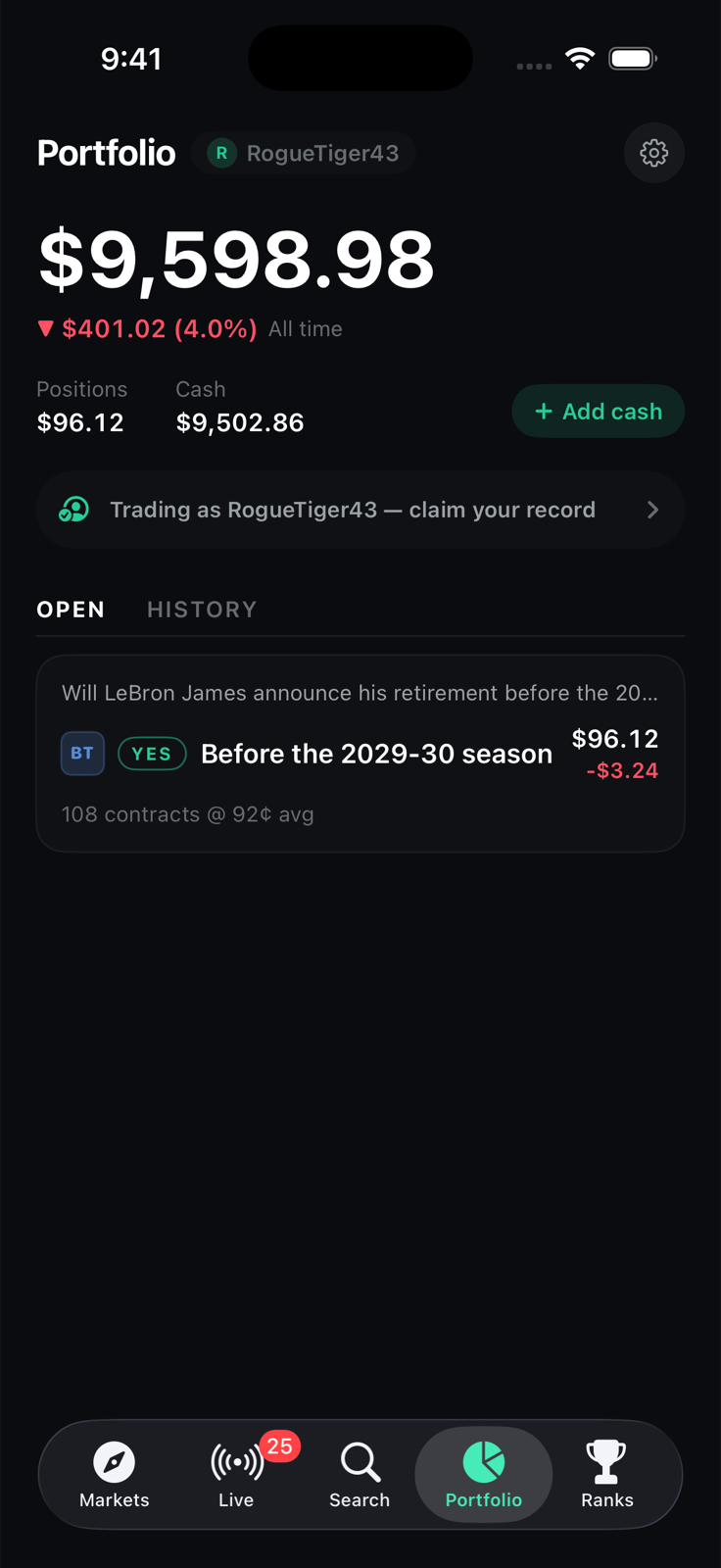
That is the case for rehearsing on paper, and it is why the PaperPicks bankroll is $100 instead of $100,000. Download PaperPicks, free on iPhone with no signup, and you get $100 of paper money at live prediction market odds, with positions that settle when the real markets resolve and a permanent record nobody can reset. The scarcity is the pedagogy. Quarter Kelly of a realistic edge is a few dollars of a $100 roll, small enough to feel boring, and exactly as boring as disciplined sizing feels with real money. The account that fires 25% at a time busts in a weekend, and the record keeps the receipt.

Run the full loop there before any of it is real: estimate p before looking at the price, compute the Kelly fraction, stake a quarter of it, cap everything at 5%, and let a hundred settlements tell you whether your 70%s were actually 70%s. If the record says yes, the same arithmetic moves to a real exchange intact, minus the fees. If it says no, the tuition was paper.
- Kelly (1956): A New Interpretation of Information Rate — the original Bell Labs paper behind the formula
- Thorp (2007): The Kelly Criterion in Blackjack Sports Betting, and the Stock Market — fractional Kelly and the drawdown probabilities quoted here
- Kalshi fee schedule — the trading fee formula used in the fee example
Facts checked against primary sources on July 24, 2026.