 PaperPicks.
An April 2026 analysis of 2.5 million Polymarket wallets found 84.1% had lost money, and the research says the damage is mostly mechanical: oversized positions, overpriced longshots, unread resolution rules, and spread paid on every panicked reversal. Process errors are trainable. A paper bankroll on live odds is the cheap place to train them.
Why do people lose money on prediction markets?#
Mostly process, not predictions. The cleanest data comes from Polymarket, where every trade is public: in April 2026, on-chain researcher Andrey Sergeenkov analyzed 2.5 million wallets and found that 84.1% had lost money overall. Only about 2% had ever made more than $1,000. An academic team that pulled all 70 million Polymarket trades from late 2022 through October 2025 found the same shape: roughly 71% of users underwater, and the top 5% of winners holding 96% of the profits.
The detail in that paper worth sitting with: the prices themselves are accurate. Contracts priced at 30¢ resolved YES about 30% of the time. So the crowd is not losing to a rigged game, and not even mainly on bad opinions. It is losing on mechanics: position size, contract selection, order type, fees. Polymarket losses are simply the best documented version of leaks that drain accounts on Kalshi and everywhere else these contracts trade.
If you just paid for one of those leaks, that is genuinely good news. Opinions are hard to fix. Process is trainable. Most prediction market losses trace to the seven mistakes below, so each gets the same treatment: the behavior, the math of the bleed, the tell that it is you, and the fix, which you can practice for free. (New to the contracts themselves? Start with how prediction markets work and come back.)
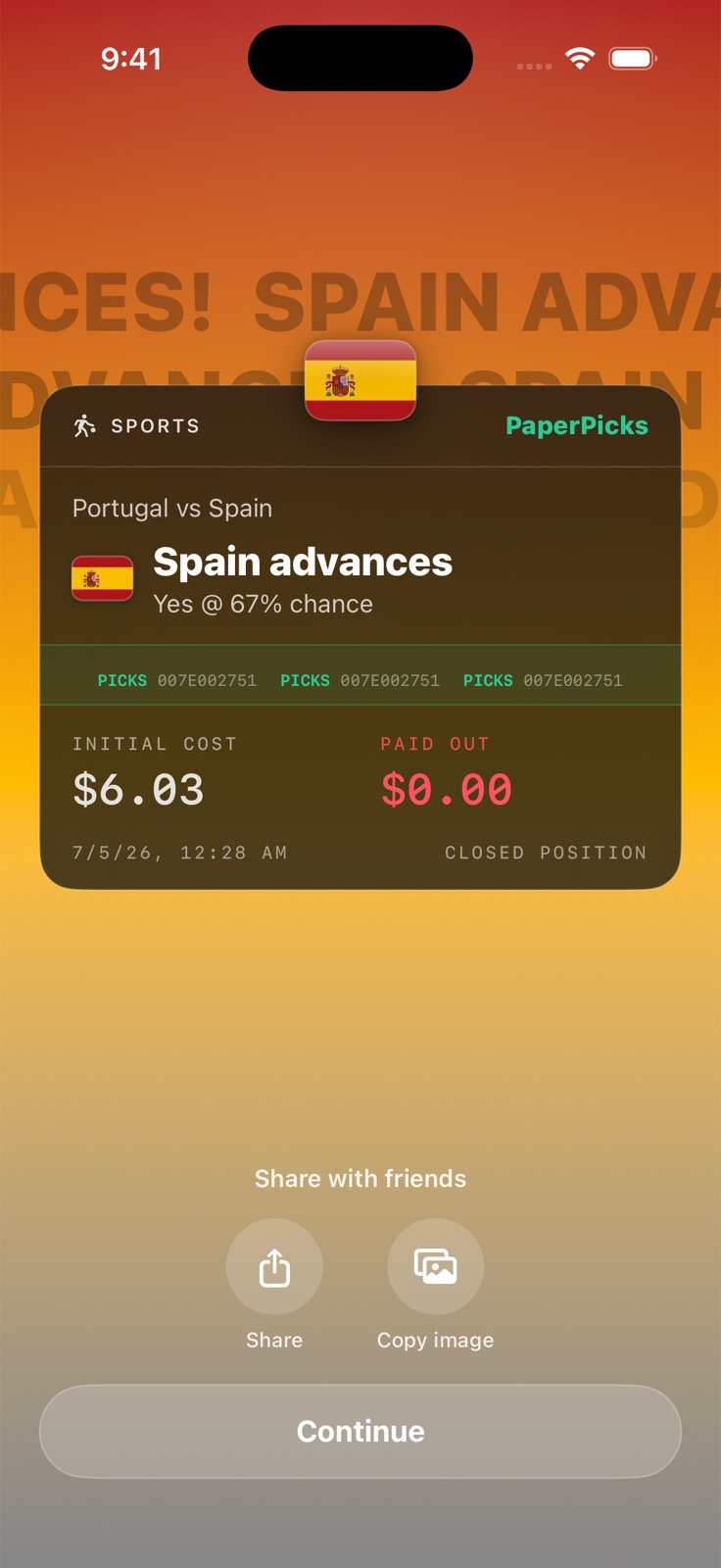
Mistake 1: oversizing every position#
Sizing by conviction. The sure thing gets a quarter of the bankroll because it is a sure thing.
The bleed is drawdown math. Bet 25% of a $100 roll per position and three losses in a row leave you a hair over $42, and from $42 the road back to even is a 137% run. Three straight losses is not a disaster scenario, either. A trader who wins 60% of the time, which would make you very good, still hits a three-loss streak in most 50-trade stretches. At 5% sizing the same streak costs about $14 and the record barely notices.
The tell: any single position above roughly 10% of your roll, or sizes that track your excitement instead of a rule. The fix is a hard cap of 3 to 5% per idea, with no exceptions you get to feel good about. The bankroll management guide has the full math, Kelly included. A paper bankroll that can actually bust is the fastest way to make the cap feel real instead of theoretical.
Mistake 2: collecting longshots#
Favorite-longshot bias is one of the oldest documented patterns in betting markets: cheap contracts tend to trade above their true probability, expensive ones below it. Retail leans into the wrong side of it. In the academic Polymarket data, 63% of trades happened at extreme prices, under 10¢ or over 90¢, and the cheap side of that is where the bleed lives.
Run the arithmetic on one. Suppose an 8¢ contract really wins 5% of the time. Spend $8 on a hundred contracts and your expected payout is $5. You burned $3 of every $8, on average, while feeling fine, because each loss is small and the occasional 12x hit erases the memory of forty misses. That is what makes it an addiction rather than an error: the feedback is wrong.
The tell: your open positions are a wall of single-digit prices, and you describe trades by their payout, not their probability. The fix: buy twenty longshots on paper and count the $0.00 receipts before real money teaches the same lesson slower. There is a longer autopsy of longshot strategies in the strategies guide.
Mistake 3: skipping the resolution fine print#
Markets settle on written criteria, not on the headline version of events. The rules name an exact data source, a deadline, and the edge cases: overtime, postponements, revised numbers. New traders read the title, form an opinion, and buy.
The math here is unforgiving because fine print does not shave your edge, it flips the contract. You can be 70¢ worth of right about the event and collect $0.00 because the market asked a narrower question than the one you answered. Ask any experienced trader about the first market that resolved technically correct against them. There is always one.
The tell: you have been surprised by a settlement while your read on the actual event was fine, or you cannot name the resolution source for a position you currently hold. The fix costs ninety seconds: read the criteria before the trade, every time. On paper, where settlement is just as real, the ambush is free.
Mistake 4: chasing the loss back#
A loss lands, and the next trade exists to erase it: bigger, sooner, and usually in a market you know less about, because the markets you know do not settle for days.
The math is the doubling ladder. Lose $10, bet $20 to get even, and a coin flip lands wrong twice one time in four. Now you are down $30 and the ladder asks for $40, which is more than half of the $70 you have left. Two rungs of recovery turned a routine loss into a bankroll event, and nothing about your forecasting got worse. Only your sizing did.
The tell: your biggest positions sit immediately after your reddest receipts, and your trade rate spikes on bad days. The fix is a boring rule that works: after a loss, the next position is the same size or smaller. If you want to learn what your own tilt feels like, bust a paper bankroll chasing once. It is the same lesson the real market sells, at 100% off.
Every mistake on this page can be made, and unlearned, in PaperPicks: live odds, real settlement, and a $100 paper bankroll that can actually bust, with no signup. Download it and pay your tuition in paper.
Mistake 5: market orders in thin books#
The screen says 40¢, so you market-buy 60 contracts. But the screen shows the last trade, not the book. In a thin market the ask might be 20 contracts at 46¢ and the rest at 52¢, so your average fill lands near 50¢ and the position opens down 20% on an idea you priced at 40¢.
This is the least famous mistake on the list and one of the best measured. In the academic Polymarket study, moving from a pure taker of liquidity to a pure maker was associated with a 36 percentage point drop in the probability of losing money, and the median user had never posted a single maker order.
The tell: your fills print consistently worse than the price that made you want the trade, and new positions start red before anything has happened. The fix: limit orders at your price or no trade, and a habit of checking the spread before the direction. How to read prediction market odds covers the book-reading part.
Mistake 6: paying the spread twice by flip-flopping#
Buy YES at 52¢ on the ask. A headline wobbles the price, you panic out at the 49¢ bid, then the story reverses and you buy back in at 52¢. You hold the position you started with, minus 6¢ per contract of spread, and each of those three fills also paid a taker fee.
On Kalshi the general formula is 0.07 times price times one minus price per contract, about 1.75¢ at 50¢, so the round trip above costs roughly 11¢ a contract once fees stack on spread. A realistic edge on a well-picked trade is 2¢ or 3¢. One moment of indecision spent four trades of edge. And since July 7, 2026, Kalshi's fee schedule is product-dependent, with per-series multipliers and some markets on their own tables, so the classic Kalshi mistakes now include assuming last month's fee math still applies. Two structural facts reward patience: maker fees run at a quarter of taker rates, and holding to settlement costs nothing extra.
The tell: your history shows YES and NO on the same market in the same day. The fix: write the exit condition before you enter, and allow yourself one round trip per market. On paper, count how many of your trades are new ideas versus u-turns. The ratio is usually a shock.
Mistake 7: promoting a hot week to an edge#
Seven wins in ten feels like proof. It is not even evidence, really: a coin flipper goes seven for ten about 17% of the time, so one dart thrower in six looks brilliant in any given week. The mistake is acting on it: doubling size and wandering into markets you do not follow.
Pew Research watched roughly 12,000 Polymarket wallets for six weeks in mid-2026 and found the most active traders, the ones trading nearly every day, were more likely to lose over $1,000 than to make over $1,000. Activity did not convert into edge. A sample does: 50 to 100 settled trades before you believe your P&L, and the number that counts is all-time, not best-week.
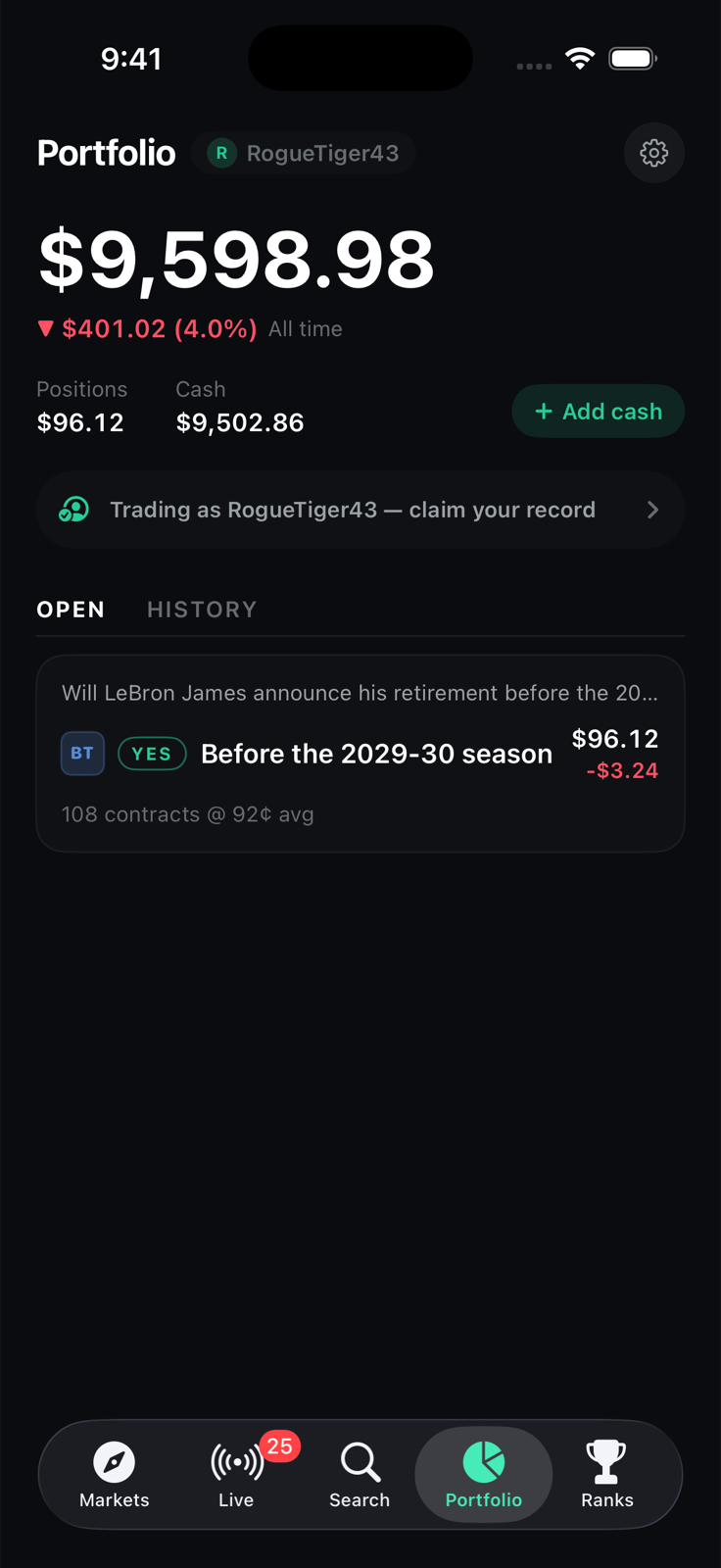
The tell: you quote your best week from memory but have to look up your all-time number. The fix is a record you cannot negotiate with, which is why PaperPicks scores everything server-side with no resets. How to get good at prediction markets covers what to do once the honest sample exists.
Prediction market tips for beginners#
The seven fixes, compressed into a process you can actually run:
- Cap every position at 3 to 5% of the bankroll.
- Default to favorites until your record proves you can price longshots.
- Read the resolution criteria before the trade, not after the settlement.
- After a loss, the next position is the same size or smaller.
- Use limit orders, and check the spread before the direction.
- One entry and one exit per market. U-turns pay the house.
- Judge yourself on 50 settled trades, never on a week.
None of this requires talent, which is the point. It requires reps, and reps are the one thing you should not buy at full price. PaperPicks is a free iPhone simulator built for exactly that: a $100 paper bankroll, live odds mirroring real prediction markets, positions that settle when the real events resolve, and a permanent record that will show you which of these seven mistakes are yours. No signup, and no real money ever. Download it from the App Store and let the receipts pile up where they cost nothing. What separates useful practice from a toy is covered in the simulator guide.
The tuition for these seven lessons is mandatory. The currency is the only thing you get to choose.
- Andrey Sergeenkov: How many traders are profitable on Polymarket — the April 2026 wallet analysis behind the 84.1% figure, data through April 1, 2026
- InGame: Study says you are almost certainly not making money at Polymarket — coverage of the Akey, Grégoire, Harvie, and Martineau paper, April 2026
- Pew Research Center: What we know about the typical Polymarket user — six weeks of trading behavior across roughly 12,000 wallets, July 2026
- Kalshi fee schedule, effective July 7, 2026 (PDF) — the current product-dependent fee tables and the maker discount
Facts checked against primary sources on July 24, 2026.