 PaperPicks.
The tools worth knowing: Kalshi's own demo and free API for mechanics and data, ContractTax and Inside Predictions for screening and alerts, TrendSpider if you already chart and want Kalshi odds on the chart, and a Kelly calculator for sizing. AI signal subscriptions like KalshiEdge and OddsShift exist and are covered honestly below, with the obvious caveat that a reliably profitable signal is worth more traded than sold. For testing whether any of it improves your picks, PaperPicks, our own free iPhone app, scores you against live odds with paper money.
The verdict#
Start with the free stack: Kalshi's own demo for the buttons, the free Trade API if you can script, Inside Predictions or ContractTax's terminal for screening, and a Kelly calculator for sizing. That covers finding markets, vetting prices, and sizing positions without spending a dollar. TrendSpider's Kalshi indicators earn a place if you already pay for charting and trade markets that react to news. The AI signal subscriptions are the only category where money leaves your pocket on a promise, and the honest way to evaluate that promise is a paper record, not a landing page.
Every tool below was checked on August 11, 2026. Where we describe a paid product's features, we are describing what its site advertises; none of these companies knows this page exists.
What counts as a Kalshi tool#
A Kalshi trade has four jobs in it: find a market worth a look, decide whether the price is wrong, size the position, and review whether your process is actually working. Every tool on this page does one of those jobs, and most disappointment in this category comes from buying a tool for the wrong job, usually paying for job two, the deciding, which is the one no tool can honestly do for you.
| Tool | Job | Cost | Checked Aug 11, 2026 |
|---|---|---|---|
| Kalshi demo (demo.kalshi.co) | Learn the interface | Free | Simulated books, web only |
| Kalshi Trade API | Data and automation | Free | REST, WebSocket, FIX; Python SDKs on PyPI |
| Inside Predictions | Screening and alerts | Free alerts | 15,000+ markets across Kalshi and Polymarket |
| ContractTax | Screening, P&L, taxes | Free terminal; paid features | Movers, settlement calendar, trade analysis |
| TrendSpider Kalshi suite | Odds on price charts | Free indicators, paid platform | Five indicators plus a custom event-link one |
| KalshiEdge | AI signals | Paid tiers, free calculators | Three-model ensemble, arb scanner |
| OddsShift | AI signals | Free tier; PRO $29/mo | Cross-platform, wallet tracking on Polymarket |
| PaperPicks (ours) | Practice and review | Free | Live odds, $100 paper bankroll, permanent record |
The official toolkit: demo and API#
The two best Kalshi tools are Kalshi's, and both are free. The demo at demo.kalshi.co is a full copy of the exchange with mock funds, the right place to learn market orders, limit orders, and the order book; our Kalshi demo account guide covers the setup and the first hour. Its limit is stated in Kalshi's own docs: the order books are simulated and prices "may not be reflective of those in real markets," so it teaches the interface and nothing else.
The Trade API is the quiet giant of the ecosystem, because most of the third-party tools on this page are built on it. It covers REST, WebSocket streaming, and FIX, market data needs no credentials at all, and order placement uses an RSA key pair you generate in account settings. The demo environment mirrors the whole thing at external-api.demo.kalshi.co, so a strategy can be coded and tested end to end without a funded account. Official Python SDKs (kalshi_python_sync and kalshi_python_async) are on PyPI, and community SDKs go further. If you can write fifty lines of Python, you can build the exact screener you wish existed instead of renting an approximation.
Screeners and dashboards#
Inside Predictions runs a free scanner across more than 15,000 live markets on Kalshi and Polymarket together, with saved filters, topic pages, and price-move alerts you can set up without paying. The cross-platform view is the draw: seeing both venues' prices on the same event is the fastest honest check on whether a Kalshi price is out of line, since the two books disagreeing is information either way. The limitation is inherent to breadth: a scanner surfaces candidates, and everything after the shortlist is still your work.
ContractTax started as a tax and P&L tool for Kalshi traders, which remains its most distinctive feature, since event-contract taxes confuse everyone. Around it has grown a full terminal: movers, a screener with alert-on-match, a settlement calendar with economic-data flags, fee-adjusted EV checks before an order, and a calibration journal. The terminal pages are free to open; the deeper analysis features are the paid product. The limitation is scope: it is Kalshi-only by design, so the cross-venue sanity check has to come from somewhere else.
Charting: Kalshi odds next to price#
TrendSpider added a Kalshi indicator suite in 2025: live odds from trending markets in companies, financials, crypto, politics, and sports, plottable on price charts as overlays or lower indicators, plus a custom indicator that takes any Kalshi event link. The indicators are free in its store, inside a platform that is itself a paid subscription. The pitch is real if you already live in charts: a Fed-decision market's odds moving against the S&P while you watch is a genuinely useful picture. If you do not already pay for TrendSpider, this is not the reason to start.
AI signal services, honestly#
Two subscription services score Kalshi markets with model ensembles and sell the output. KalshiEdge runs three independent scorers over every active market every 30 minutes, only fires a high-confidence signal when all three agree, flags arbitrage when YES and NO sum under a dollar, and publishes free EV and Kelly calculators that need no account. OddsShift analyzes markets across Kalshi and Polymarket with five models, tracks smart-money wallets on Polymarket's chain, keeps live probabilities free, and charges $29 a month for verdicts and entry targets as of August 2026.
Both dashboards are more convenient than building the same thing yourself. Neither escapes the structural question you should ask of every signal seller in every market: a model that reliably identified mispriced contracts would make its owner more money trading quietly than retailing subscriptions. That does not make the services useless, since aggregated data, plain-English resolution summaries, and arb flags have value independent of the verdicts. It makes the verdicts the part to treat as one more opinion. The arbitrage flags specifically are pure arithmetic and real when they appear, though fills at both prices are the hard part, and the opportunities are small and brief on a book as watched as Kalshi's.
Before paying for any signal service, paper trade its picks for thirty days and let the record answer. A seller confident in their signals will survive the audit; your bankroll should not fund the ones that will not.
Calculators: the unglamorous edge#
The highest-return tool in prediction markets is a position-size calculator, because oversizing kills more bankrolls than bad picks do. Kelly math for binary contracts is simple enough to live in a spreadsheet cell, KalshiEdge's free calculators do EV, break-even probability, and Kelly sizing without an account, and ContractTax keeps a page of them too. What the calculator cannot supply is its key input, your true probability estimate, which is the whole game. Our bankroll management guide covers the formula, the fractional-Kelly discount that keeps variance survivable, and the drawdown math that justifies it.
The practice layer: where tools get audited#
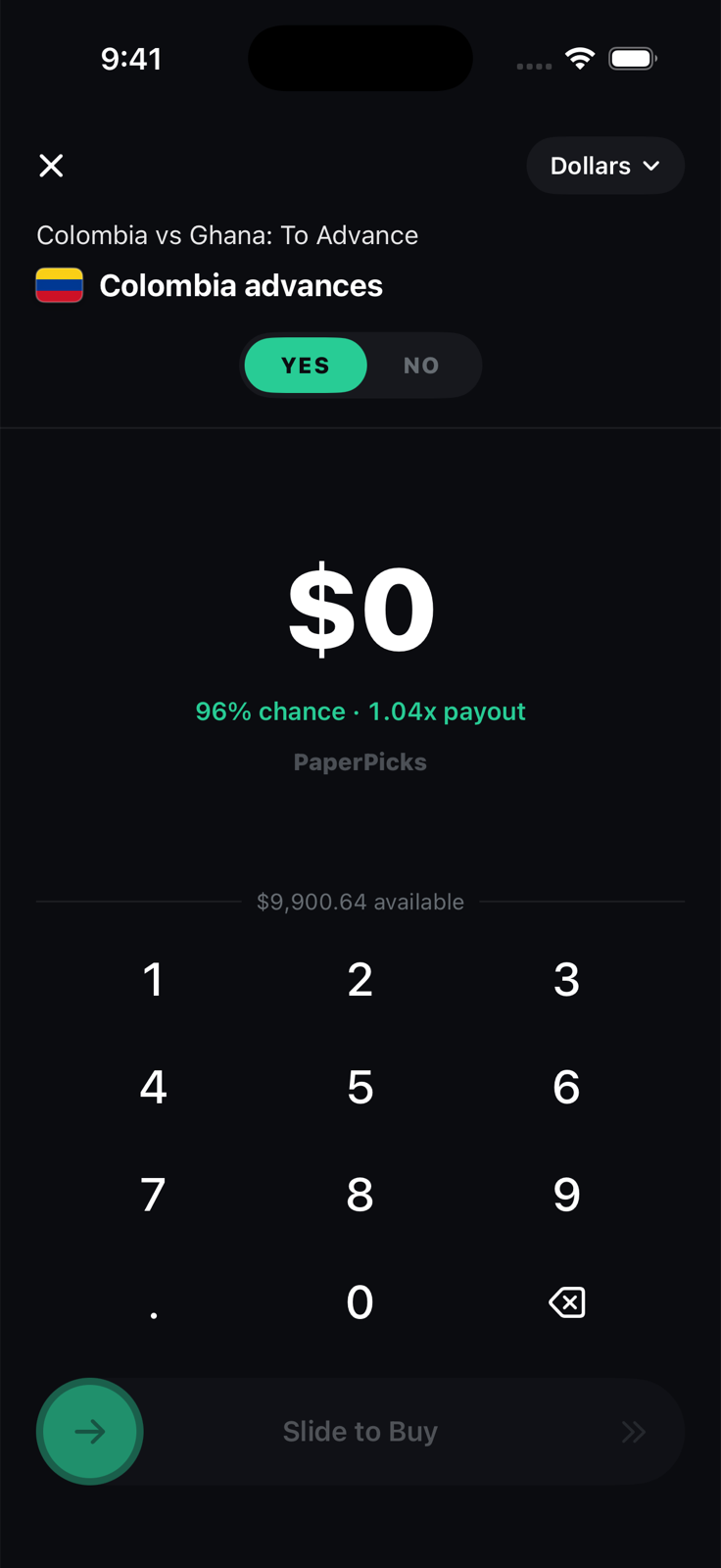
PaperPicks is ours, so read this entry knowing that. It is a free iPhone app that hands you a $100 paper bankroll against live odds mirroring public prediction markets, the same event contracts trading on Kalshi: 7,000+ markets across sports, politics, economics, crypto, and entertainment. Positions settle when the real markets resolve, and the record is permanent and server-scored, which is precisely what makes it the audit layer for everything above. A screener's shortlist, a signal service's verdicts, your own read of a Fed market: each becomes a testable claim when it has to survive a month of paper positions at real prices. There is no signup and no money in or out, ever. The limitation: iPhone only, and paper cannot reproduce the fear of real dollars. Download it on the App Store.
The stack that makes sense#
For most people the right Kalshi stack is short. Learn the interface in Kalshi's demo in an afternoon. Screen with Inside Predictions or ContractTax's free terminal, whichever fits how you browse. Size every position with a Kelly calculator at a fraction of full Kelly. Audit any paid signal, and your own judgment, on paper before real dollars ride on either. The tools that survive that process earn their place; the strategies guide covers what to actually do with them, and everything on this list will still exist after your paper record tells you whether you needed it.
- Kalshi docs: API reference and demo environment — the Trade API surface, external demo hosts, and the demo-prices warning
- ContractTax Terminal — the live screener, movers, and settlement-calendar feature set as advertised
- Inside Predictions scanner — the cross-platform market count and free alert setup
- TrendSpider: Live Kalshi odds on TrendSpider — the Kalshi indicator suite and custom event-link indicator
- OddsShift — the free tier, PRO pricing, and model-ensemble approach as advertised
- KalshiEdge — the three-model ensemble, arbitrage scanner, and free calculators as advertised
Facts checked against primary sources on August 11, 2026.