 PaperPicks.
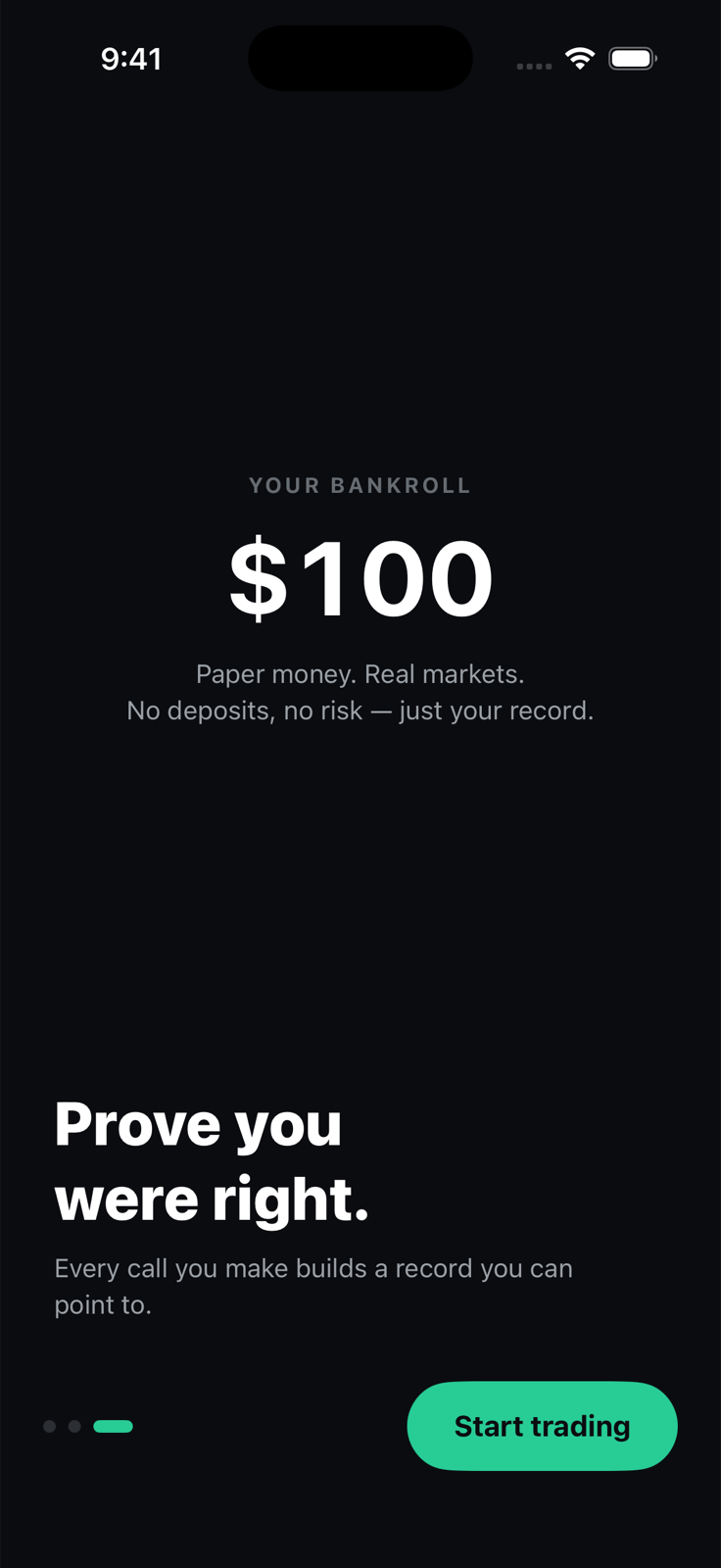
A prediction market simulator lets you trade real event contracts with fake money. Judge any of them on four things: live odds, settlement by the real market's ruling, a bankroll that can bust, and a permanent record. PaperPicks is the free iPhone app built around those rules: $100 paper bankroll, live odds on 7,000+ markets, no signup.
What is a prediction market simulator?#
A prediction market simulator lets you trade event contracts, the YES or NO questions priced between 1¢ and 99¢ on exchanges like Kalshi and Polymarket, with fake money instead of real deposits. The good ones mirror live market odds and settle your positions when the real events resolve, so your paper record measures real forecasting skill.
That second sentence is where the category splits. Fake money is table stakes; every simulator has it. What varies is whether everything around the money stays real. A prediction market with fake money still teaches you to trade, as long as the prices, the settlement, and the consequences are all real. When the prices are fake too, it teaches you to click buttons.
Four tests that separate a simulator from a toy#
Live odds. The skill you are building is reading a moving price: what 34¢ means, why it jumped to 51¢ on a headline, whether the crowd overreacted. A simulator that invents its own odds, or refreshes them occasionally, cannot teach any of that. The price on your screen has to be the real market's probability, moving when the real market moves.
Real settlement. Positions should resolve when the real-world event resolves, by the real market's ruling, not when an app decides to grade your pick. Settlement is where beginners get ambushed: the game ends, and the contract resolves NO anyway, because the resolution criteria said something more precise than the headline. You want that ambush to happen on paper.
A bankroll that can bust. Most play money is worthless because there is too much of it. Hand someone $10,000 and a reset button and every position is trivially small, busting costs nothing, and practice decays into entertainment. A play money prediction market only works when the money feels scarce, because scarcity forces sizing decisions, and sizing is most of what separates traders who last from traders who donate.
A record you cannot fake. If the point of practicing is finding out whether you are good, the scorekeeping has to be honest: server-scored P&L, full history, no do-overs. A simulator that lets you wipe your record will get its record wiped the day after every bad week.
If a simulator lets you reset your balance, its leaderboard is meaningless and its lessons are optional. Scarcity is the teacher.
The four kinds of prediction market paper trading#
The options sort into four types. Knowing which one you are looking at saves you an afternoon.
Browser simulators. A wave of web apps now paper trades Kalshi and Polymarket markets from a desktop tab, usually behind an email signup, with mock balances and leaderboards. The category is real and parts of it are good. It is also uneven in exactly the ways the four tests predict: odds that lag the exchange, settlement handling that varies by site, balances you can often reset. If you trade from a desk, try one, and ask how it settles and what persists before you trust its leaderboard.
Exchange demos. Kalshi runs an official demo at demo.kalshi.co: a separate web account with mock funds, originally built for developers testing bots against the API. It is free and real, and it is the best way to learn Kalshi's interface before wiring in money. But it runs simulated order books, and Kalshi's own docs warn that demo prices "may not be reflective" of real markets. A thin, stale book will fill you at prices that would never print live. Polymarket has no demo at all. And neither exchange offers a prediction market practice account inside its main app; real trading there means identity checks and deposits. Full breakdowns in Kalshi paper trading and Polymarket paper trading.
Educational sandboxes. Classroom tools built to teach how market scoring works. You trade against a market-making formula, not a crowd, so prices move when you trade rather than when news breaks. Useful in a lecture on mechanism design. Not practice, because the thing that makes markets hard, other people, is missing.
Native app simulators. Prediction markets get checked from a couch, during the game, on a phone. A simulator that lives there fits how people follow this stuff. PaperPicks is the iOS one: live odds, real settlement, a permanent record. Specifics below.
| Simulator type | Where prices come from | How positions settle | What persists |
|---|---|---|---|
| Browser simulators | Live exchange odds, often delayed | Varies by site | Varies; balances often resettable |
| Kalshi demo | Simulated order books | Mock settlement in the demo | Separate demo account, no public record |
| Educational sandboxes | A market-making formula, not a crowd | The formula or the instructor | Classroom scores |
| PaperPicks | Live odds mirroring public markets | When the real market resolves | Permanent record, leaderboards |
Paper trading prediction markets on PaperPicks#
PaperPicks is a free iPhone app, and a free prediction market simulator in the plainest sense: free download, every market open, and no real money anywhere in the system. Nothing can be deposited, wagered, or cashed out.
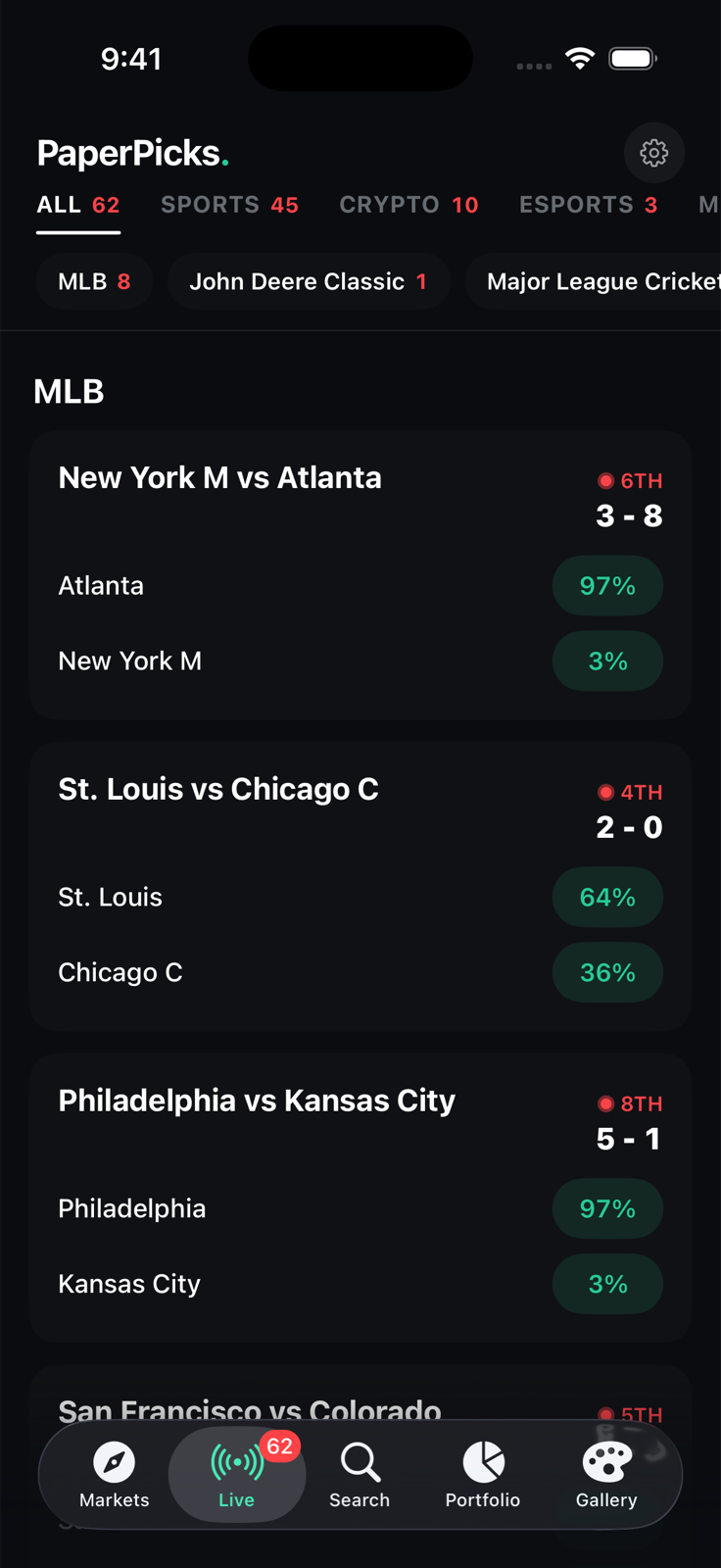
The odds are live, mirroring public prediction markets, the same event contracts real traders are moving on Kalshi: NFL and NBA games, elections, Fed decisions, Bitcoin price targets, award shows. 7,000+ markets run across sports, politics, economics, crypto, and entertainment. When news breaks and the real price moves, your screen moves with it, in play, point by point.
You start with the same $100 paper bankroll as everyone else, and there is no reset button. Settlement is real: positions resolve when the underlying markets resolve, and the receipt arrives as a push notification, including the ones you would rather not open.
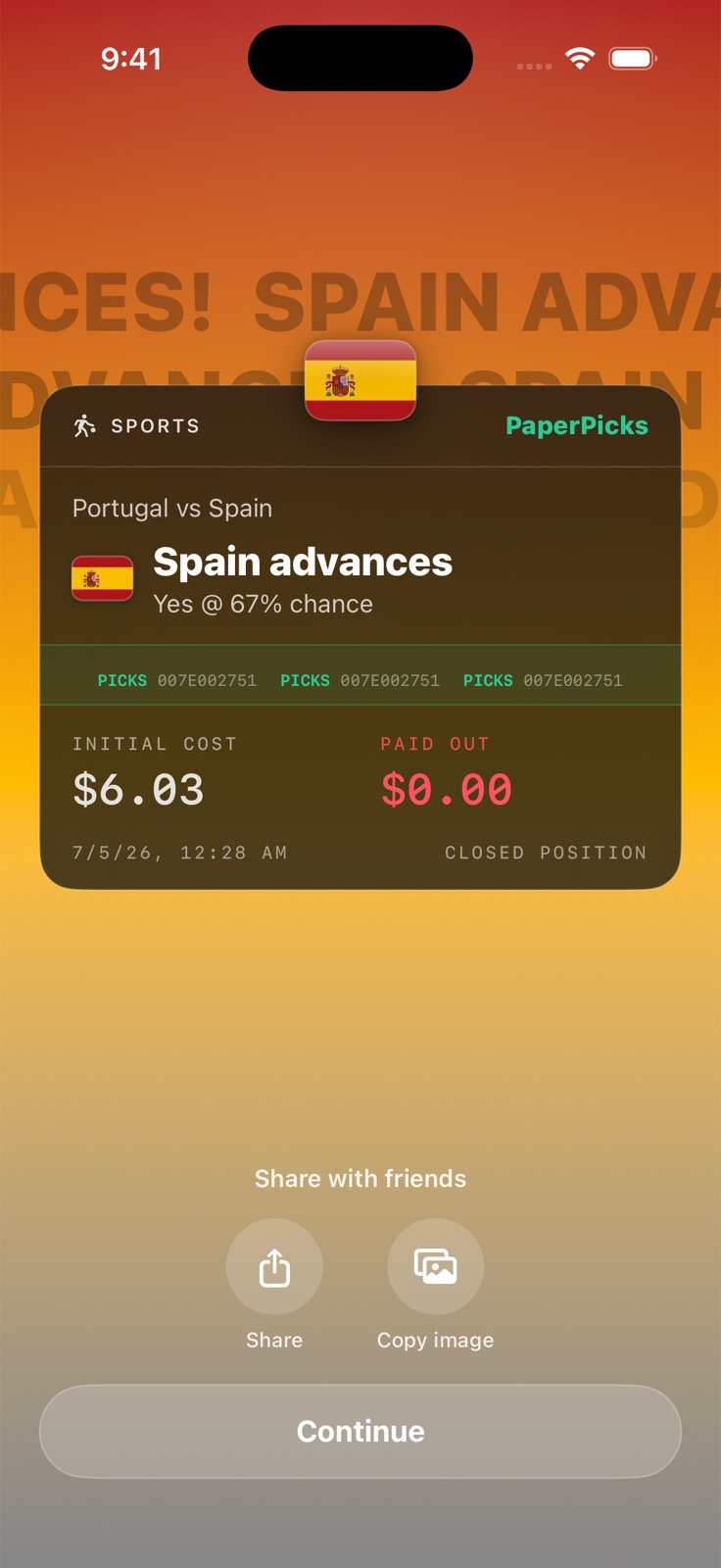
The record is permanent and scored server-side. No resets; deleting your account is the only fresh start. Permanence is also what turns the social layer into a prediction market game worth playing against friends: public profiles, following, tailing or fading other people's picks, leaderboards where every number was earned. A leaderboard of resettable bankrolls ranks nothing.
There is no gate at the door either. No signup and no KYC, because there is no money to protect. You are trading paper within seconds of first open.
What a simulator can and cannot teach you#
The limit first: no simulator reproduces the feeling of real dollars leaving your account. That fear changes decisions, and paper cannot manufacture it. Anyone claiming otherwise is selling something. What paper does is make every other lesson cheap.
- Prices turn into probabilities. Buying YES at 80¢ wins often and pays little. Buying at 20¢ pays big and usually loses. Expected value stops being a formula and starts being a reflex, and receipts are the reps.
- Sizing gets learned the fast way. A roll that can bust teaches position sizing better than any Kelly criterion explainer, because the lesson arrives with a consequence attached.
- Resolution criteria stop surprising you. Markets settle on precise rules, not headlines, and paper is the cheap place to learn the difference.
- Your edge gets measured. Most retail prediction-market traders lose money. A few months of paper P&L tells you which group you would join, before the tuition is real.
If the record says you are consistently sharp across a real sample, not one hot week, read how to get good at prediction markets and push further. If it says you are not, the simulator just paid for itself with money you never spent.
How to start (about 30 seconds)#
- Download PaperPicks from the App Store. Free, iPhone only.
- Open it. An anonymous account is created automatically; there is nothing to fill in.
- Pick a live market, tonight's game or the next Fed decision, and buy YES or NO with paper money.
- When the real market settles, so does your position. Grow the $100, or bust it and be glad it was paper.
Either way you get a straight answer, scored against the same odds the real market printed. That is the entire argument for practicing this way.
- Kalshi docs: Test in the demo environment — the official demo description and the market-realism warning
- Kalshi Help Center: Creating and using a demo account — consumer setup walkthrough for the demo
Facts checked against primary sources on July 24, 2026.